Awards & Fellows Nominations

Ecologies of a Changing Planet
Submit an abstract for an individual talk or poster presentation at our upcoming virtual conference, Ecologies of a Changing Planet.
Read more
Media Tip Sheet
Predators in Palau, coastal conservation, changing fire patterns in the U.S. Southwest, and rethinking environmental reviews are just some of our latest journal highlights.
Read more
Candidates for Election
Our 2026 election will kick off in mid-September and run until the last week of September. Members are encouraged to get familiar with the candidates before voting opens!
Read moreJournals & Publications
-
ESA's Journals and Publications

The Ecological Society of America has over 100 years of journal publishing history and offers some of the most widely read and cited journals in the field of ecology. The seven journals in our portfolio encompass a wide range of paper types to include an array of aims and scope of study, making them an important and accessible outlet for scientists, researchers, practitioners, professionals, citizen scientists, and others seeking to publish their work. ESA staff provide editorial support with our publishing partner, John Wiley & Sons, and several discounts towards publication in ESA journals are available from our publisher and from ESA. Publishing in ESA journals contributes to ESA programs for students, early career researchers, and underrepresented groups, and we thank our editors, reviewers, authors, and readers for their support.
-
Frontiers in Ecology and the Environment
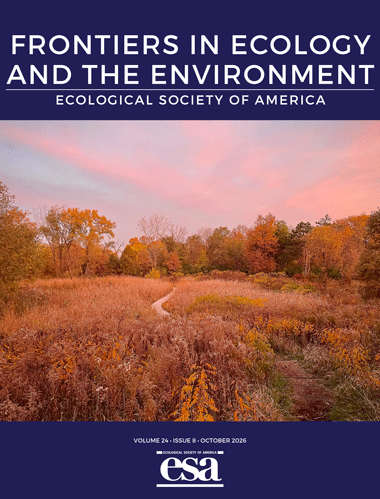
For urban residents, urban greenspaces render a wide range of ecosystem services, like stormwater management, cooling, and access to nature. To maximize these benefits, greenspaces—such as the one pictured here in Chicago—must be distributed within cities in an equitable and just way. However, the legacies of historical, discriminatory housing policies (i.e. redlining) can still be seen in the modern spatial patterns of urban greenspaces in US cities. As compared to their non-redlined counterparts, once-redlined neighborhoods have less overall greenspace and individual greenspaces within those neighborhoods are smaller in size and less connected. These findings, summarized by Gallo et al. in the October issue of Frontiers, add to the mounting evidence that ecosystem services provided by greenspaces have been systematically absent from redlined communities for decades. To reduce nature inequities in cities, those who can influence urban design must support planning policies written through an equitable and anti-racist lens.
-
Ecosphere

For the African wild dog (Lycaon pictus), an endangered, wide-ranging species in Botswana's Okavango Delta, landscape connectivity is essential, allowing dispersing individuals to find mates and establish new packs. Yet connectivity in the Delta changes as seasonal flooding transforms the landscape. In their article in the September issue of Ecosphere, Hofmann et al. examined the relative influence of seasonal dynamism and model realism on the predictive accuracy of landscape connectivity models. Increasing model realism markedly improved predictions, whereas incorporating seasonal dynamism improved only the simpler models. Nevertheless, seasonal flooding shifted the location of important dispersal habitats, indicating that landscapes must be protected at sufficiently broad scales to encompass seasonally shifting dispersal corridors.
-
Ecology
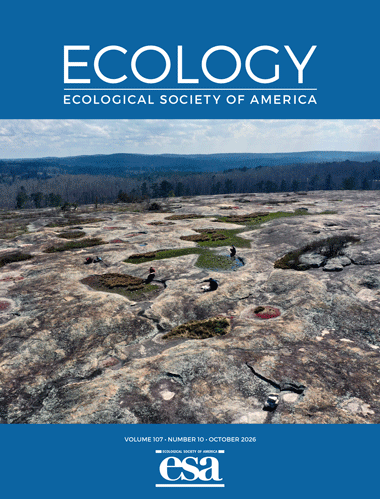
On the October cover of Ecology, an aerial drone photograph captures a granite rock outcrop featuring natural pool depressions in DeKalb County, Georgia, where researchers record abundance and occupancy data of local taxa. Numerous rare species are endemic to these rain-filled granite outcrop pools, including snorkelwort (Gratiola amphiantha). In their article in the September issue of Ecology, Wyngaarden and DeMarche show that pool soil depth and pool area are strong drivers of snorkelwort occupancy in these systems. The authors also demonstrate that single-season surveys for snorkelwort presence are insufficient despite the species’ relatively high detection probability, estimating that two repeat detection surveys within a season are required to achieve 95% confidence of detection when truly present.
-
Ecological Monographs
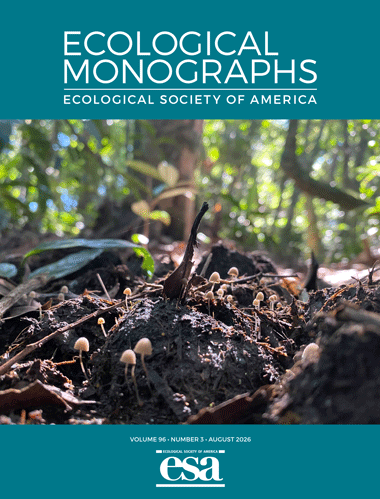
Ground-dwelling mammals can influence belowground processes through multiple pathways, including the deposition of feces that provide resources for decomposers, as well as their foraging activities and physical disturbance of the forest floor. Using a 14-year mammal exclusion experiment in the Brazilian Atlantic Forest, the article by Ribeiro et al., published in the May issue of Ecological Monographs, demonstrates that mammalian biomass alters litter quality and soil chemistry, suggesting that ground-dwelling mammals can accelerate nutrient cycling in tropical forests and that ongoing defaunation may have cascading consequences for ecosystem functioning. The August cover image shows a lowland tapir (Tapirus terrestris) dung latrine colonized by fungi in the Brazilian Atlantic Forest.
-
Ecological Applications
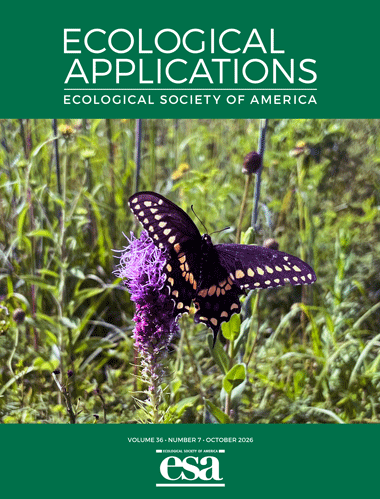
The October cover of Ecological Applications features a black swallowtail, Papilio polyxenes, as it visits the flowers of prairie blazing star, Liatris pycnostachya, in year nine of a tallgrass prairie restoration experiment in northeastern Kansas, USA. In their article in the September issue of Ecological Applications, Cheeke et al. applied two restoration techniques to a post-agricultural field prior to seeding—solarization or mowing of the initial non-native vegetation, with or without inoculation with native soil microbes. Both solarization and inoculation improved the floristic quality of the plant community over several growing seasons, increasing the abundance of disturbance-sensitive species like prairie blazing star.
-
The Bulletin
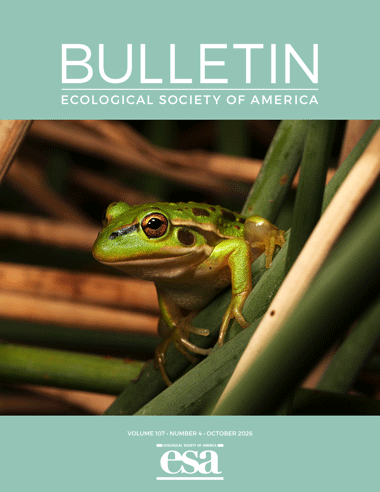
The October issue of the ESA Bulletin highlights ESA's Education Committee, which guides education initiatives within ESA, and provides an overview of their 100+ year history in the society. The issue also includes several commentaries discuss challenges faced by our ecologists and addresses the importance of communicating science with a call to publishers to consider authors' needs and their readers when designing templates. The issue also provides a record of recent society actions, including the Spring 2026 ESA Governing Board meeting minutes and the names of the candidates for the Fall 2026 ESA Election. Members, please cast your votes before the election closes on October 26!
-
Earth Stewardship

We are delighted to announce a call for submissions for Earth Stewardship. This exciting new Open Access journal, launched with our publishing partner, John Wiley & Sons, calls for a broad spectrum of scientifically and technologically innovative and groundbreaking contributions including cross-cultural perspectives from leading researchers, policymakers, traditional custodians of land and sea and indigenous communities. Earth Stewardship publishes applied and theoretical articles to promote a broad, intercultural, and participatory foundation for earth stewardship.

2027 Annual Meeting
Are you already thinking about our next meeting? Are you interested in submission types, deadlines, location, travel options and dates? Select the following link and to go to www.esa.org/toronto2027/
Read more
ECOLOG-L
Access our long-standing email Listserv. Topics in the field of ecology include, research updates, news, job opportunities and more. A free subscription to the list serve allows you to choose what content you want delivered to you and how often.
Read more
Donate to the Science of Ecology
Make a difference and fund programs which empower, educate and embolden both the current and next generation of scientists in the vast field of ecology.
Read more