2011

Snowflakes still hold mystery

This post contributed by Nadine Lymn, ESA Director of Public Affairs Their silent, shimmery beauty has long stirred human aesthetic appreciation and for centuries individuals have sought to unravel the secrets of snowflakes.  Why are there so many varieties?  Why do all snowflakes have six “arms”?  And why does each flake appear unique, no matter how many fall from the…

Read More

The rising of the sun and the running of the deer

This post contributed by Liza Lester, ESA communications officer In November, Norwegians Arnoldus Schytte Blix, Lars Walløe and Lars Folkow brought us the news that running reindeer cool themselves through open-mouthed panting, as Sara Reardon explains at ScienceNOW. Their heavy winter coats are so effective at insulating the animals from arctic temperatures that they have trouble dumping excess heat through…

Read More

ESA Policy News: December 22

Here are some highlights from the latest ESA Policy News by Science Policy Analyst Terence Houston.  Read the full Policy News here. APPROPRIATIONS: CONGRESS PASSES BILL FUNDING AGENCIES THROUGH FY 2012 The week of Dec. 16, Congress passed H.R. 2055, an omnibus bill which funds the government through the remainder of the current fiscal year (FY) 2012, which ends Sept. 30,…

Read More
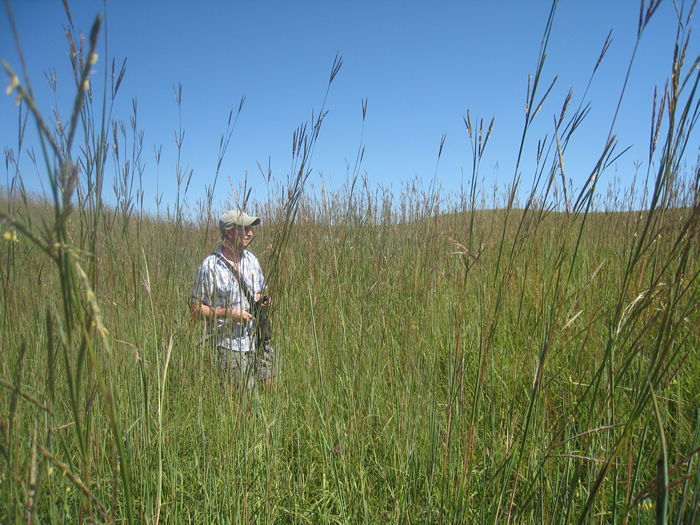
Jesse Nippert in the tall grass at Konza Prairie Biological Station

Tallgrass prairie: the invasion of the woody shrubs

As a Kansas boy, Jesse Nippert spent his youth wanting to escape the state, but found himself drawn inexorably back. Underlying the sea of grass is an interplay of water, fire, competition and consumption as enchanting as any ecosystem—and the balance of forces is shifting.

Read More
landsat 5 satellite artistic rendering

Goodbye, Landsat 5

This post contributed by Liza Lester, ESA communications officer Four hundred miles above the Earth’s surface, a satellite slides into lonely oblivion. After collecting and broadcasting earthly imagery for a remarkable quarter century past its expected 3-year lifespan, Landsat 5 is failing. Over the years, US Geological Survey engineers have contrived quite a few patches and work-arounds for malfunctions on…

Read More

Congress leaps before it looks at Keystone pipeline permit review efforts

This post contributed by Terence Houston, ESA Science Policy Analyst H.R. 3630, the Middle Class Tax Relief and Job Creation Act of 2011, which comprises an extension of the payroll-tax cut and unemployment benefits, also  includes a provision intending to fast-track approval of the Canadian Keystone XL Pipeline project. The move is the latest in a series of unprecedented maneuvers…

Read More

ESA Policy News: December 9

Here are some highlights from the latest ESA Policy News by Science Policy Analyst Terence Houston. Read the full Policy News here. CONGRESS: ENVIRONMENTAL RIDERS LOOM FOR MUST-PASS MEASURES Before the first session of the 112th Congress adjourns at the end of next week (or weekend), it will take up a short, but important list of measures to keep the…

Read More

Tinkering with worm sex to shed light on evolution

This post contributed by Nadine Lymn, ESA Director of Public Affairs The roundworm Caenorhabditis elegans (C. elegans) is a tiny laboratory animal that researchers have worked with for decades.  As a hermaphrodite, C. elegans makes both sperm and eggs and can reproduce by self-fertilization.  In contrast to humans, where hermaphrodites are rare, for C. elegans, this is its normal state.  …

Read More

Learning the lingo of science communication that resonates

This post contributed by Terence Houston, ESA Science Policy Analyst Many political observers would liken the current climate on Capitol Hill to a virtual total breakdown of civil communication where differing sides have become increasingly entrenched in their own ideological philosophies, either unwilling or incapable of meeting in the middle. The latest calamity concerning the failure of the so-called “supercommittee”…

Read More

Briefing highlights importance of ecosystem services in Gulf of Mexico

On November 16, the Consortium for Ocean Leadership joined with the Communication Partnership for Science and the Sea (COMPASS) and the National Research Council of the National Academies to sponsor House and Senate briefings on restoring the ecosystem services that support economic vitality in the Gulf of Mexico. The briefing highlighted findings from a recent National Academies report that examined…

Read More