Official logo of the ESA.

ESA Action Alert: Comment on proposed rescission of the Endangered Species Act’s definition of “harm”

Earlier this month, the United States Fish and Wildlife Service and the National Marine Fisheries Service proposed a new rule that could limit the scope of Endangered Species Act protections. The agencies are accepting public comments on the proposed rule change until May 19, 2025. Background: Currently, the Endangered Species Act prohibits certain actions that โ€œharass, harm, pursue, hunt, shoot,…

Read More

A Rousing Success at the 2025 Mid-Atlantic Chapter Meeting

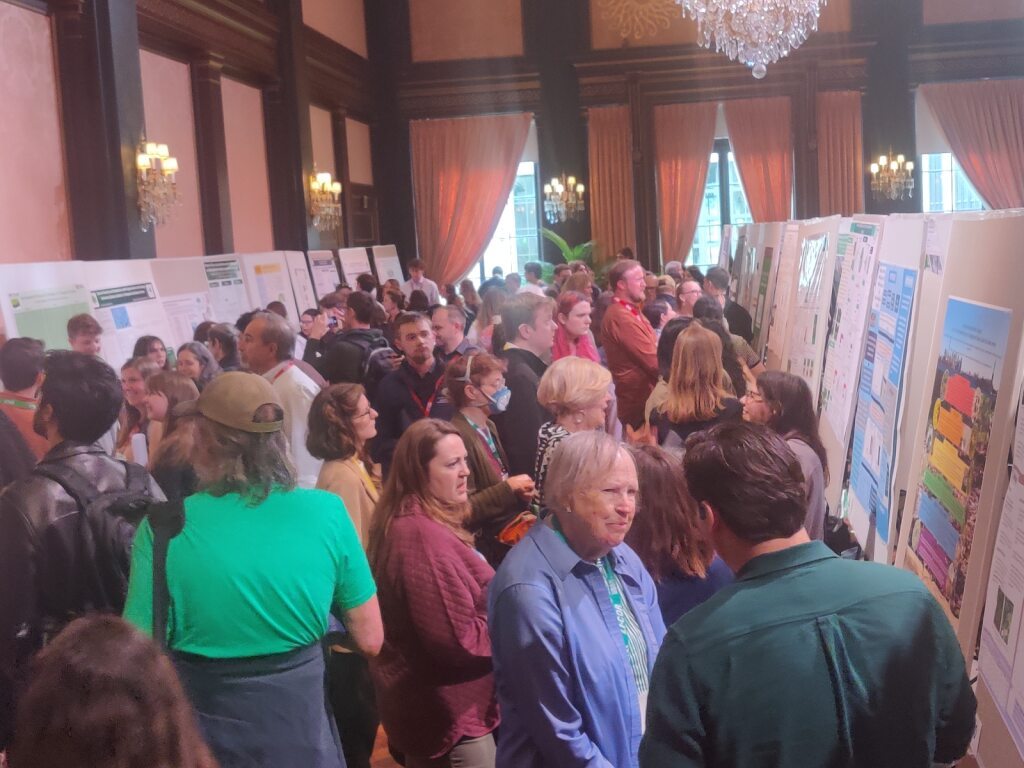
Contributed by ESA Mid-Atlantic Chapter Chair Lea Johnson On April 5, nearly 300 ecologistsโ€”faculty, students, and practitionersโ€”gathered at Longwood Gardens for what weโ€™re told may have been the largest meeting of ESAโ€™s Mid-Atlantic Chapter in its decades-long history. As chair of the regional chapter for the year, I was also chair of the meeting โ€“ so the enthusiastic participation this…

Read More
Official logo of the ESA.

ESA Policy Action Alert for Federal Research

Dear ESA Community, Recent U.S. administration executive orders (EOs) affecting research funding, data sets, the federal STEM workforce, diversity, equity, and inclusion (DEI) in federal agencies and scientific research funding programs have introduced uncertainty and concern for the ecological community. While the full implications remain unclear, we are steadfast in our commitment to advocating for our mission, programs. ESAโ€™s Commitment…

Read More
COP16. Colombia. Paz con la Naturaleza

COP16 Dispatch: Week 2 Open Source and LLMs, Reflections from the Back Row of COP16

Cristian Romรกn shares unique insights from attending COP16 in Cali, Colombia, exploring the interplay of science, policy, and equity. Highlights include challenges with proprietary biodiversity tools, ethical concerns surrounding AI in policy compliance, and academia’s role in negotiations, raising critical questions about accessibility, collaboration, and power dynamics.

Read More
COP16. Colombia. Paz con la Naturaleza

COP16 Dispatch: Week 2 How Does Science Participate in the Biodiversity Convention? The Case of Invasive Species at COP16

At COP16 in Cali, October 2024, Alejandra Osejo-Varona, PhD Candidate in Anthropology at Rice University, shares insights on how scientists and decision-makers collaborated to address invasive alien species (IAS). The conference presented scientific tools and assessments, such as the IPBES report and IUCN toolkit, to guide the implementation of Target 6 of the Kunming-Montreal Global Biodiversity Framework.

Read More
COP16. Colombia. Paz con la Naturaleza

COP16 Dispatch: Week 1 From the talk to the World, Women Scientists Discuss Citizen Science

Women scientists and community leaders are reshaping conservation through citizen science, integrating Indigenous knowledge, and advocating for policy change. At COP16-Columbia, Cindy Julianty and Tanya Majdumar showcased how grassroots initiatives led by women empower local communities, preserve biodiversity, and ensure sustainable conservation efforts. Their stories highlight resilience, innovation, and a call for global action.

Read More
COP16. Colombia. Paz con la Naturaleza

COP16 Dispatch: Week 1 Biodiversity Credit Market Combined Session Report

At COP16 in October 2024, Claire Bandet, a masterโ€™s student at the University of Pennsylvania, shared insights on biodiversity credit markets. The discussions ranged from defining the term to exploring its risks and potential, with two panels offering opposing views: one advocating for an effective market and the other arguing against it.

Read More
COP16. Colombia. Paz con la Naturaleza

COP16 Dispatch: Week 2 Analysis of a Truly Nature-Positive Economic Growth

David Baldwin shares insights from a COP16 side event, hosted by the University of Cambridge, that discussed shifting toward a nature-positive economy, prioritizing ecological and social well-being over traditional GDP. Panelists argued for a transformation, not just a transition, integrating Genuine Progress Indicators and indigenous knowledge to reshape economic systems for biodiversity and sustainability.

Read More