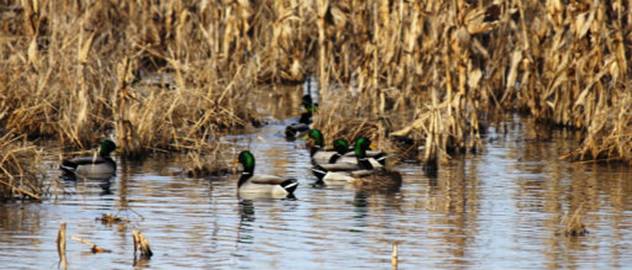
usda conservation buffers Chesapeake Bay

Bridging the public-private land divide for conservation

For much of the world, high-intensity industrial farming produces food with high efficiency, but puts the squeeze on other plant and animal life. Wildlife is mostly sequestered on preserves. But is this the best way to maximize food and biodiversity? Or are there other configurations that might improve mobility of wildlife and benefit other ecosystem services without cost (and possibly with benefit) to private land owners?

Read More

Federal research investment and its benefits for society

In seeking to improve fiscal restraint through a federal budget that has burgeoned over the past decade (largely due to expansion of mandatory spending coupled with decreased revenue intake), lawmakers have been eyeing numerous areas of discretionary spending, including scientific research due to the fact that cutting spending in these areas is more politically feasible than addressing the growth of…

Read More

Call for nominations! Joan Ehrenfeld Award for Best Student Presentation in Urban Ecology

Normal 0 false false false EN-US X-NONE X-NONE /* Style Definitions */ table.MsoNormalTable {mso-style-name:”Table Normal”; mso-tstyle-rowband-size:0; mso-tstyle-colband-size:0; mso-style-noshow:yes; mso-style-priority:99; mso-style-parent:””; mso-padding-alt:0in 5.4pt 0in 5.4pt; mso-para-margin-top:0in; mso-para-margin-right:0in; mso-para-margin-bottom:10.0pt; mso-para-margin-left:0in; line-height:115%; mso-pagination:widow-orphan; font-size:11.0pt; font-family:”Calibri”,”sans-serif”; mso-ascii-font-family:Calibri; mso-ascii-theme-font:minor-latin; mso-hansi-font-family:Calibri; mso-hansi-theme-font:minor-latin;} At the annual Ecological Society of America Annual Meeting in Minneapolis, MN next month, the Urban Ecosystems Ecology (UEE) section will present its second…

Read More

Ellen Anderson to receive ESA’s 2013 Regional Policy Award

Former Minnesota state senator is energy and environment senior advisor to the governor   By Nadine Lymn, ESA director of public affairs Each year since 2008, the Ecological Society of America (ESA) recognizes an elected or appointed local policymaker who has an outstanding record of informing policy decisions with ecological science. This year, ESA’s Regional Policy Award will go to…

Read More

ESA Policy News: July 12

Here are some highlights from the latest ESA Policy News by Science Policy Analyst Terence Houston.  Read the full Policy News here. APPROPRIATIONS: HOUSE CJS BILL CUTS SCIENCE INVESTMENT On July 9, the House Appropriations Committee released its Commerce, Justice and Science and Related Agencies Appropriations Act of Fiscal Year (FY) 2014, which includes funding for the Department of Justice, Department…

Read More
Same Data, Different Century. Sometimes I believe I was born to be a 19th century naturalist. Compiling long term records of flowering phenology involves stitching together old data (for example, this herbarium specimen from 1895) with new data (a phenology observation collected on a smartphone app in 2013). As I trek across Mount Desert Island in the 21st century, I am keenly aware of the naturalists who came before me; in my mind, I insert myself into the troupe of Harvard boys whose field notes and camp logs have become my baseline data. I really love S. A. Eliot's sweater. Caption, Caitlin McDonough MacKenzie. Image, Designed by Michael MacKenzie Herbarium Specimen courtesy of the College of the Atlantic Herbarium Smartphone Screenshot of original data courtesy of fulcrum app Photograph of the Harvard boys in 1880 courtesy of the Northeast Harbor Library Photograph of Caitlin McDonough MacKenzie by Lisa McDonough

In phenology, timing is everything

If you’ve ever thought that botany doesn’t involve enough time travel, you are not alone. Plant ecologists studying climate change and and the timing of flowering are constantly wondering ‘is this happening when it used to happen?’ My job would be infinitely easier if I had access to a time machine.

Read More

ESA Policy News: June 28

Here are some highlights from the latest ESA Policy News by Science Policy Analyst Terence Houston.  Read the full Policy News here.   CLIMATE CHANGE: OBAMA OUTLINES PLAN TO REGULATE GREENHOUSE GASES On June 25, President Obama announced his plan to mitigate greenhouse gas emissions. The plan seeks to implement federal action on addressing climate change in lieu of  Congress that…

Read More

In defense of federally-funded research

A continued drive towards fiscal belt-tightening by lawmakers in Congress has spurred unprecedented attempts to curb federal investment in scientific research. With a continued unwillingness by members of both major parties in Congress to tackle a comprehensive bipartisan plan to reduce the national debt that includes mandatory spending reform and tax reform, non-defense discretionary spending programs are continuing to be…

Read More