Moving forward on environmental literacy

This post contributed by Nadine Lymn, ESA Director of Public Affairs Connect with gamers.  Connect with religious communities.  Work with public health professionals.  Explore.  Make the connection to a green economy.  Find champions in the private sector.  Engage with your community.  These were all messages those participating in last week’s Ecology and Education Summit heard from a wide range of…

Read More

Investing for the Future: Federal Science Funding and its Benefits for Communities

A primary role of policymakers is to serve as the voice of the community they represent. At the federal level, hearing elected officials speak on the House or Senate floor or at a town hall, is one channel citizens use to stay engaged in the issues of the day. Wouldn’t it be wonderful if lawmakers could more often use these forums to tout what the latest scientific and technological advancements are contributing to their community?

Read More

Frog legs: more than just a culinary curiosity

Frog legs are a culinary tradition in many cultures—featured in French and Cantonese cuisine, among others—and have been showing up in American cuisine as well, often as a culinary curiosity. In a recent article in the Washington Post, for example, frog legs were presented as a delicacy that could become more popular with American consumers if presented in a new way.

Read More

From the Community: waste and the environment

Turning wasteful Styrofoam packaging into biodegradable, mushroom-based materials, the current news on Hungary’s alumina sludge disaster, Frito Lay changes back to original chip bag packaging after consumer complaints about the “eco-friendly” bags and cities wasting water and using new technology to turn wastewater into energy.

Read More

Gulf seafood safety and the government’s response

Since oil began leaking from a rig in the Gulf of Mexico last April, concerns regarding the safety of the region’s seafood abounded. Now, more than two months after the leak was sealed, public officials, federal scientists and even President Obama have all been saying that seafood from the Gulf region is safe to eat. So why aren’t consumers digging in? Several local leaders from the region impacted by the oil spill addressed this topic last week during the most recent hearing of the National Commission on the British Petroleum Deepwater Horizon Oil Spill and Offshore Drilling in Washington, D.C.

Read More

Field Talk: Local spearfishing stories tell of fish depletion in Chile

Historically, spearfishing involved a diver, a harpoon (or spear or trident) and access to an abundant source of fish. However, it has evolved over the centuries—especially within the last few decades—to include boats, masks, snorkeling gear, scuba tanks, wet suits and even spearguns. The modernization of equipment means divers are able to stay underwater for hours and fire mechanically propelled spears at faster rates than a person is able to throw. The result, in theory, is a more fruitful catch.

Read More

From the Community: the wisdom of birds, felines and spores

Tim Birkhead explains what song bird research can contribute to human health, Surprising Science describes the evolution of a feline’s roar (or meow), a Geophysical Research Letters study assesses the world’s dwindling groundwater supply, Nature News interviews Gabriela Chavarria—the U.S. Fish and Wildlife Service’s top science adviser—and Chris Palmer’s book reveals faking in nature videos. Here are stories in ecology from the last week in September.

Read More

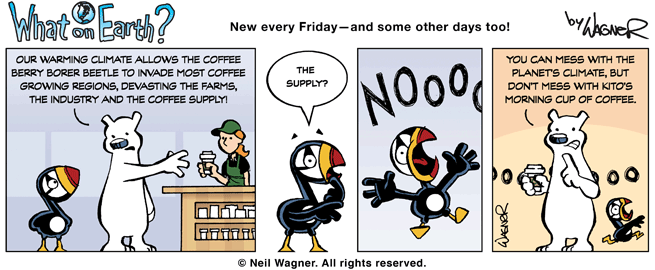
Injecting humor into climate change: Interview with cartoonist Neil Wagner

Many science communicators suggest that the key to effectively translating climate change research is to keep the message concise, accurate and interesting, all in one tight package. Perhaps the most streamlined of platforms to communicate this science is a comic strip in which the cartoonist has just a few panels to neatly and accurately convey the findings, the alternative viewpoint and the gravity of the issue at hand. Oh, and it should be funny too.

Read More

Science in a “culture of news-grazers”

When was the last time you sat down after dinner to watch the local news? How about the last time you forwarded or received a link to a news story? Odds are, with the prevalence of social networking, blogs and email, you probably sent or received news in some form during your lunch break this afternoon. In fact, just by reading this post you are providing evidence that consumers tend to prefer cherry picking news throughout the day, rather than replenishing their news supply all at once.

Read More

From the Community: street lamps, traffic lights and nuclear energy

Songbirds become disoriented by street lamps, plants adapt to the conditions near Chernobyl, a newly discovered spider spins gigantic webs with the strongest known biological material in the world, traffic light experiment shows promise of reducing emissions and easing traffic congestion and researchers discuss the Daily Show with Jon Stewart as an outlet for communication science to the public. Here are some of the latest stories in ecology for the second to last week in September.

Read More