ESA Peer Review Academy
Developing the Next Generation of Ecological Peer Reviewers
Application Period: by November 15, 2026
Duration: 24 months, virtual
Format: Online workshops, mentored peer review, and editor engagement
Program Vision
The ESA Peer Review Academy prepares emerging ecological scientists to contribute rigorous, ethical, and constructive peer reviews while strengthening the future of ecological scholarship and scientific communication.
Overview
The ESA Peer Review Academy is a professional development program for early-career ecologists, environmental scientists, and interdisciplinary researchers seeking practical training in peer review and scholarly publishing. Through editor-led workshops, mentored review assignments, and discussion with ESA journal editors, participants build the skills, confidence, and judgment needed to evaluate ecological research and write constructive reviewer reports.
Goals and Learning Outcomes
The Academy will help participants:
- Understand peer review, editorial workflows, reviewer selection, reviewer responsibility, decision-making, and ethics, values and risks of AI-assisted peer review.
- Evaluate ecological and related research questions, methods, analyses, interpretations, transparency, and reproducibility.
- Write clear, constructive, timely, and actionable reviewer reports.
- Apply ethical practices related to confidentiality, conflicts of interest, authorship, and research integrity.
- Build professional networks with ESA editors, mentors, and peers, and publishing staff.
Program Components
1. Interactive Workshops
Virtual sessions led by ESA editors and publishing experts will cover peer review fundamentals, ecological research and publication types, reviewer reports, statistics and reproducibility, ethics, conflicts of interest, diversity and inclusion, artificial intelligence, and editorial decision-making. Recordings will be available to participants.
2. Mentored Peer Review
Scholars may complete 3-4 ESA journal reviews per year, work with a scientific mentor, receive editor feedback, and learn how reviewer comments inform editorial outcomes. The number of review invitations will depend on the subject matter expertise required and the volume of manuscripts received in that area.
3. Editor Roundtables during the ESA Annual Meeting
Small-group conversations with ESA editors will address reviewer selection, common strengths and weaknesses in reviews, editorial triage, decision-making, and pathways into editorial service.
Scholar and Mentor Responsibilities
Scholars will complete confidentiality and conflict-of-interest requirements, attend required sessions, submit reviews on schedule, engage constructively with mentors and editors, and provide program feedback.
Mentors will discuss assigned manuscripts, review draft reports, provide feedback, and support scholars’ development as reviewers.
ESA will formally recognize mentor contributions through the Society’s newsletters and communication channels. ESA will provide administrative support for the program; however, no monetary funding is available to either the mentee or the mentor.
Eligibility
Scholar applicants should be senior postdoctoral researchers, early-career faculty, research scientists, or professionals in ecology, environmental science, conservation biology, ecosystem science, or related fields. Applicants should have published at least two original research papers, preferentially including one with ESA journals, demonstrate interest in peer review and scientific publishing, identify a scientific mentor before your application, participate in training, and complete peer review on schedule. ESA encourages applications from all members who qualify.
Benefits
Academy scholars will receive formal training, hands-on reviewing experience, editor interaction, personalized feedback, expanded professional networks, and a digital badge. Outstanding participants may be considered for future ESA reviewer and editor recruitment, recognition programs, editorial board service, or advanced publishing training opportunities. There is no monetary fund to support this initiative.
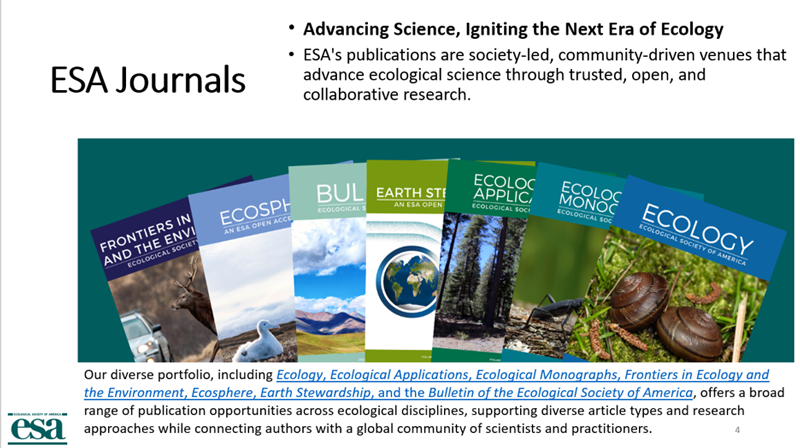
Potential Participating Journals
Application Process
Mentee:
- Candidate and mentor contact information, and mentor endorsement.
- Research specialty (10 words or fewer) and the journal(s) you prefer to support.
- A biography of 50 words or fewer and a letter of interest of 100 words or fewer.
- A CV labeled Lastname.Firstname.pdf.
Mentor:
- Research specialties of 10 words or fewer, and the journal(s) you prefer to support.
- A biography of 50 words or fewer, a letter of interest of 100 words or fewer.
- A CV labeled Lastname.Firstname.pdf.
Please apply here!
Agreed Mentors
Mentees are welcome to select their own mentors, whether from the participating editors, their principal investigator (PI), or another senior scientist they wish to engage with during this peer review training program.
(additional mentors will be added as more information becomes available)
Senior & Advancing Generations (SAGE) Section Mentors
- Carmen Cid, next chair, Senior & Advancing Generations (SAGE) Section
- George Middendorf, Chair & Council Representative, Senior & Advancing Generations (SAGE) Section
- Kenneth Klemow, Past Chair, Senior & Advancing Generations (SAGE) Section
Additional Editor Mentors
- Peter Adler, Utah State University
- Monica B. Berdugo, University of Marburg
- Diane Ebert-May, Michigan State University
- Caroline Farrior, The University of Texas at Austin
- Jessica Forrest, University of Ottawa
- Jennifer Funk, University of California, Davis
- Elisabeth Huber-Sannwald, Instituto Potosino de Investigación Científica y Tecnológica
- Ryosuke Iritani, RIKEN Center for Interdisciplinary Theoretical and Mathematical Sciences
- Darrel Jenerette, University of California – Riverside
- Saheed Olaide Jimoh, Rice University
- Gaurav Kandlikar, Louisiana State University
- Jason Kaye, Pennsylvania State University
- John Kominoski, Florida International University
- Burt Kotler, Ben-Gurion University of the Negev
- Tom Langen, Clarkson University
- Quresh Latif, Bird Conservancy of the Rockies
- Christopher Lepczyk, Auburn University
- Lisa McManus, University of Hawaiʻi at Mānoa
- Jorge Fernando Saraiva de Menezes, Mamirauá Institute for Sustainable Development
- Thomas Miller, Rice University
- Matthew Mitchell, The University of British Columbia
- Michael Monaghan, Leibniz Institute of Freshwater Ecology and Inland Fisheries
- Madan Oli, University of Florida
- Germán Orizaola, University of Oviedo
- Robert Parmenter, Valles Caldera National Preserve
- Andrea Paz, Université de Montréal
- Gregory Pec, University of Nebraska at Kearney
- Julio Postigo, Indiana University
- Whitney Preisser, Kennesaw State University
- Julian Resasco, University of Colorado
- Matteo Rizzuto, Concordia University
- Annabel Smith, University of Queensland
- Haiyang Zhang, Hebei University
- Elise Zipkin, Michigan State University
- Sarah Zohdy, US Centers for Disease Control and Prevention