Ehrenfeld Award 2025
First Place
Margaret Ann Schaefer

Personal Statement
I am a master’s student in the Department of Entomology at University of Maryland where I study urban tree ecology. For my research I look at the health of street trees in Baltimore City and the communities of insects that live on them. I initially graduated from Kalamazoo College, Michigan with degrees in Biology and English. For my undergraduate thesis I studied butterfly eclosion in captivity, and have since worked in native butterfly rearing, prairie restoration, and algae production.
I am most interested in urban insect ecology, and understanding how urbanization factors such as temperature impact trees, insects, and their relationship to each other. For my current research I am examining if climate prediction ratings for individual tree species can be used to predict the health of urban trees. I am also sampling throughout the City of Baltimore to examine how the city’s history of redlining impacts young, growing trees. For my research I sample growing trees of many different native species in redlined and non-redlined neighborhoods to better answer the questions of variability both within and throughout cities
Accepted Abstract: Examining urban tree health as a method of predicting species-specific climate adaptation
As climate change increases stress for trees through changes in temperature, water availability, and air quality, cities may serve as an early indicator of climate effects and their future impact on trees. While urban trees can provide ecosystem services and mitigate effects like urban heat islands and air pollution, their ability to thrive is also impacted by these same stressors. It is unlikely that all tree species will be affected by climate change similarly. Recent modelling efforts, such as those produced by the USFS Climate Change Tree Atlas, predict that some tree species will do well with a shifting climate in urban areas, while others will be unable to adapt. Studying a cohort of recently planted urban street trees across the gradient of temperatures within a single city provides an avenue to examine how changing climate could impact various species. Through this we can answer: 1. Are climate resilience predictions reflected accurately across the different species, and 2. Are species predictions reflected along an urban temperature gradient?
To examine these questions, we revisited young street tree cohorts of several native species originally measured in the 2018 Baltimore Tree Inventory. These species were selected based on climate adaptation predictions as released by the USFS Climate Change Tree Atlas, where some were predicted to do well in the Greater Baltimore region, and others poorly. The individual trees selected were growing in neighborhoods experiencing a gradient of air temperatures, which had been recorded over the summer of 2018. We quantified growth over the past six years and assessed different tree health, damage, and insect population metrics. Many of these tree response variables varied across species, generally but not exclusively matching climate predictions. Additionally, some species were more negatively impacted by growing in warmer urban conditions than others. This knowledge can help influence urban planting decisions in anticipation of increased climate stress to ensure ecosystem services are maintained and predict the future outcomes for these species across the region.
Honorable Mention
Evan Hogyeum Joo
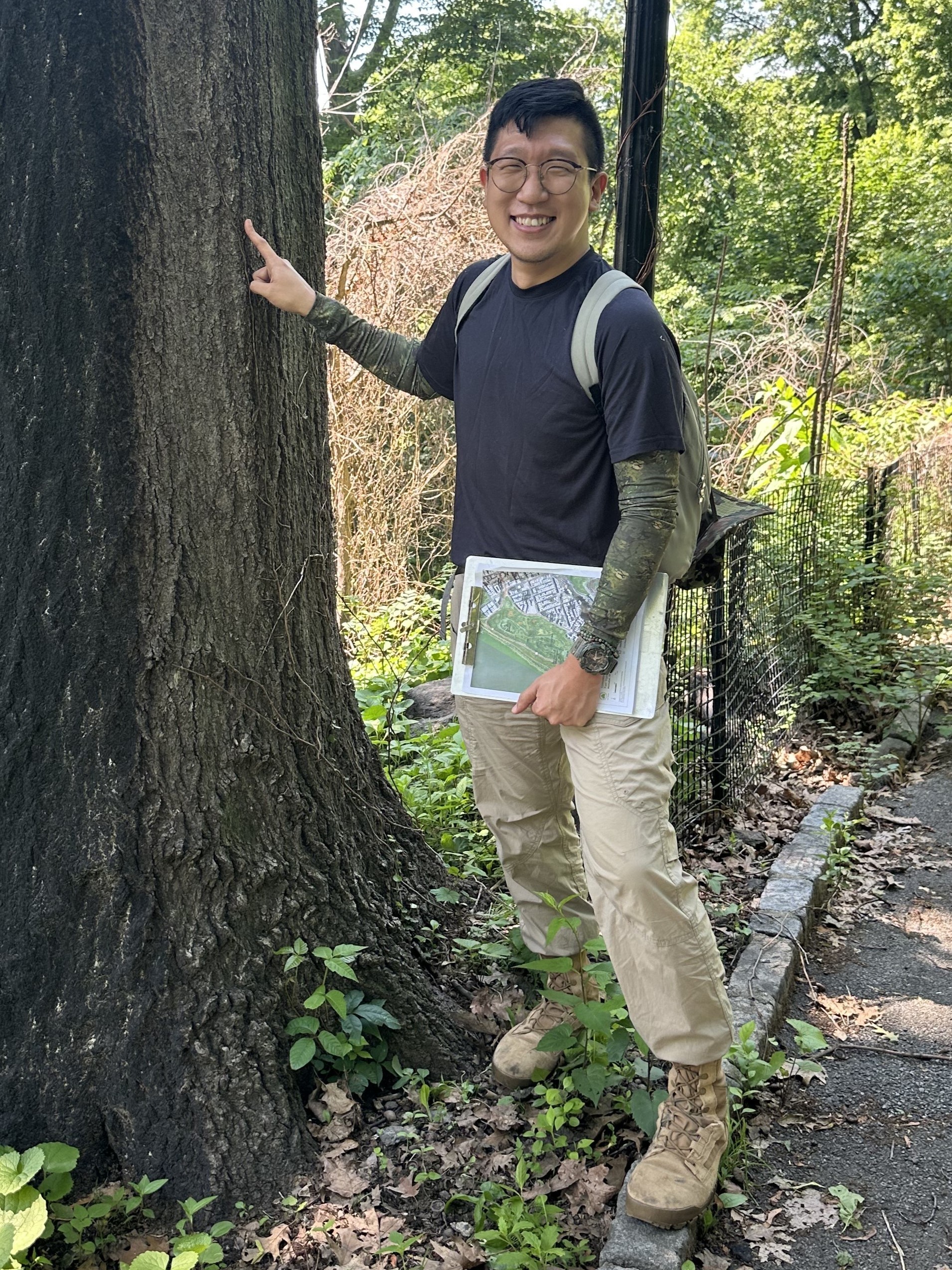
Personal Statement
I’m Hogyeum Evan Joo, a PhD candidate in Ecology & Evolution at Rutgers University – New Brunswick (advisor: Dr. Myla Aronson). Prior to Rutgers University, I received my bachelor’s degree in Ecosystems and Human Impact (Sustainability Studies Program) with a minor in Geospatial Science from Stony Brook University in 2019, and received an MS in Sustainability Management from Columbia University in 2021.
As a member of the Aronson Lab for Urban Ecological Studies, I study the intersection of humans and nature in urban green spaces, using New York City’s urban parks as my study system. My multidisciplinary background, along with my interest in approaching ecological questions through multiple lenses, has led me to blend social and ecological dimensions together in my study topics.
I’ve been involved in several projects that highlight equitable access to urban green spaces, as well as addressing the question of how we define the various aspects of the ‘quality’ of green spaces. For my dissertation work, I work on projects that investigate the unique complexities and heterogeneity of urban green spaces from multiple angles – 1) socio-environmental drivers of human-nature interaction in urban parks, using community science usage patterns, 2) plant biodiversity, habitat type heterogeneity based on vegetation’s structural complexity, and compositional differences resulting from different management practices, 3) addressing luxury effect and the relationship between socioeconomic background of park-adjacent residents and distribution of plant species with varying compositions
Additionally, I have a project that investigates the relationship between environmental knowledge and the level of support for environmental conservation in college students who are currently enrolled at institutions that have protected landscapes on their campuses.
I plan to finish my degree program by the spring of 2026, and continue bridging ecological theory and urban practice through collaborative, interdisciplinary research that advances both urban biodiversity conservation and the sustainability of cities.
Accepted Abstract: Habitat heterogeneity, not park size, drives plant biodiversity in urban green spaces
Habitat heterogeneity plays a crucial role in maintaining biodiversity. In urban green spaces (UGS), habitat heterogeneity is shaped by management, design, and human use. However, we lack an understanding of the variety of habitat types and biodiversity UGS is capable of supporting. In this study, we hypothesized that size and habitat heterogeneity of UGS are important predictors of species richness, and these relationships are mediated by park type. To test this hypothesis, we we sampled the vegetation of four park types: a) Neighborhood Parks (n=11), b) Community Parks (n=5), c) Playgrounds (n=7), and d) Nature Areas (n=4), in New York City, USA.
We categorized habitat types within each park using canopy density, shrub density, and mowing/weeding intensity of the herbaceous layer. We conducted 10 x 2m transect surveys of plant species composition within each habitat type.
The surveyed parks supported 26 habitat types. Community Parks (avg size=34.54ha) supported the highest number of habitat types (avg=8.2) and species richness (avg=159.8), Neighborhood Parks (avg size=2.23ha) had the next highest number of habitat types(avg=6.45) and species richness (avg =112.36). Nature Areas (avg size=23.58ha) and Playgrounds (avg size=0.35ha) had the lowest habitat heterogeneity and species richness (avg=4.75 and 3.14; 83.75 and 46.57, respectively).
Park size showed significant, but weak, positive relationships with habitat heterogeneity (p=0.023, R2 = 0.191) and species richness(p=0.012, R2= 0.226). Notably, habitat heterogeneity reported a strong positive relationship to species richness (p<0.0001, R2=0.721).
Post-hoc comparisons (Tukey’s HSD test) indicated that mean habitat heterogeneity significantly differed among park types (ANOVA p<0.0001). Community Parks had a significantly higher number of habitat types compared to Nature Areas (p<0.05) and Playgrounds (p<0.005). However, Playgrounds had significantly lower habitat heterogeneity than Neighborhood Parks (p<0.05). When comparing species richness across park types, we found a significant difference only between Community Parks and Playgrounds (p<0.005). Our study highlights that habitat heterogeneity is a stronger driver of species richness than park area in urban green spaces. These results suggest that increasing habitat heterogeneity within existing parks may be a key strategy for enhancing urban biodiversity.