Perrin illustrations

New Frontiers in Eco-Communication

Guest post by Clarisse Hart, Outreach and Education Manager at Harvard Forest   Today in the Hyatt hallway, I passed a colleague with an imposing nametag terraced by four colors of ribbon. He is an ESA donor, a moderator, and two other things I can’t recall (possibly a juggler). This year my nametag has a ribbon, too. It’s a regular…

Read More

ESA Policy News August 7: Science groups oppose travel bill, White House outlines climate change costs

Here are some highlights from the latest ESA Policy News by Policy Analyst Terence Houston. Read the full Policy News here.    GOVERNMENT AFFAIRS: SCIENTIFIC SOCIETIES OPPOSE TRAVEL RESTRICTIONS BILL The Ecological Society of America (ESA) is among 70 research organizations that signed a letter expressing concern with legislation moving in the Senate that would impose restrictions on the ability of…

Read More
Rim Fire, California 2013. Mike McMillan, USFS.

The Rim Fire one year later: a natural experiment in fire ecology and management

The enormous conflagration known as the Rim Fire was in full fury, raging swiftly from crown to crown among mature trees, when it entered the backcountry of Yosemite National Park in California’s Sierra Nevada in late August 2013. But inside the park, the battle began to turn, enacting a case study in the way management decisions and drought can combine to fuel large, severe fires.

Read More
Fish attend coral in the coral reef ecosystem at Palmyra Atoll National Wildlife Refuge.

Fish biodiversity protects coral reefs

Science Bulletins: Fish Biodiversity Protects Coral Reefs from AMNH on Vimeo. In tropical coral reefs, plant-eating fish and other herbivores support the dominance of the living coral by eating seaweed. Also known as macro algae, seaweeds create energy from sunlight through photosynthesis, like plants, and support much of the life in the sea. But they also compete with young corals…

Read More

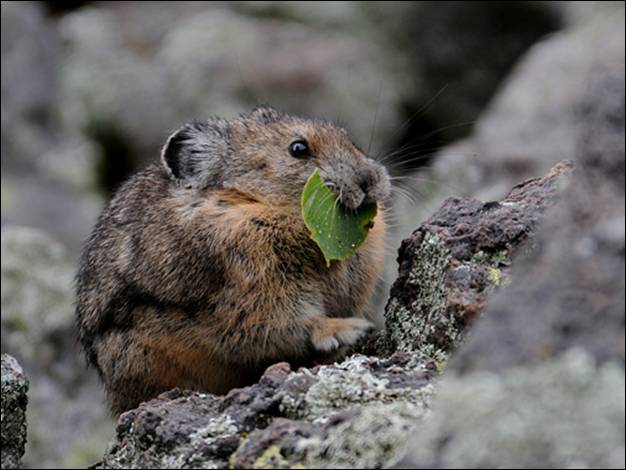
Pikas act as ‘climate indicators’

The Oscar-winning Disney movie “Frozen” includes a living snowman character named Olaf that would melt and die under the 70 degree temperatures humans and many other animals prefer. Of course, there are a number of species in the animal kingdom sensitive to heat conditions humans generally find preferable. Some of these are fellow mammals , but not all, are limited…

Read More

Making Your Science Matter

This guest post is by Chris Creese, a member of the “Eco Comm Crew” behind the upcoming “Beyond the Written Word” science communication workshop (#15) at ESA’s Annual Meeting in Sacramento. See previous posts from EcoComm Crewmates: “Parachuting In: Writing that Drops Readers into the Field of Ecology” by Clarisse Hart, “From Oceans to Mountains, it’s all about Ecology…Communication!” by…

Read More

ESA Policy News July 25: Senators review EPA power plant rules, rural CA receives drought relief, ESA to aid Interior science group

Here are some highlights from the latest ESA Policy News by Policy Analyst Terence Houston. Read the full Policy News here.  EPA: MCCARTHY TESTIFIES BEFORE SENATE COMMITTEE ON CLEAN POWER PLAN A recent Senate Environment and Public Works (EPW) Committee hearing offered US Environmental Protection Agency (EPA) Administrator Gina McCarthy her first opportunity to testify before Capitol Hill legislators on her…

Read More

Congressional briefing highlights climate adaptation, mitigation efforts in Midwestern United States

On July 17th, the Environment and Energy Study Institute held a briefing entitled “Climate Impacts in the Midwest: Becoming More Resilient.” The briefing showcased a variety of climate change effects happening now in the Midwest as well as various local efforts to mitigate and adapt to these environmental changes. Rosina Bierbaum, Professor of Natural Resources and Environmental Policy at the…

Read More

Federal efforts underway to streamline research grant review process

  A recent report from the National Science Board seeks to ease the burden of private investigators and lower costs associated with the overall merit review process for federal research grants. The National Science Foundation’s National Science Board (NSB) has released a report outlining recommendations to reduce administrative workload for principal investigators of federally funded research. The report is in…

Read More
A lovely Augochlora pura extends part of its tongue. A. pura is a member of the relatively short-tongued Halictidae family, uprettily known as the sweat bees. The small, solitary bee is one of the most common bees of forests and forest edges in the eastern United States, and a promiscuous attendant to many flower species. Collected by Phillip Moore in Polk County, Tennessee. Photograph by Phillip Moore. Photo courtesy of the USGS Bee Inventory and Monitoring Lab.

For bees (and flowers), tongue size matters

When it comes to bee tongues, length is proportional to the size of the bee, but heritage sets the proportion. Estimating this hard to measure trait helps scientists understand bee species’ resiliency to change. Ecologists will report on this and other pollination research news at the Ecological Society of America’s 2014 Annual Meeting in Sacramento, Cal., August 10-15.   For…

Read More