June research news from the Ecological Society of America
June 30, 2026
For Immediate Release
Contact: Mayda Nathan, mayda@esa.org
The Ecological Society of America (ESA) presents a roundup of four research articles recently published across its esteemed journals. Widely recognized for fostering innovation and advancing ecological knowledge, ESA’s journals consistently feature illuminating and impactful studies. This compilation of papers explores the origins of Snake River trout, the lasting effects of redlining, how climate change shifts the playing field for a bee-mimicking insect, and a simple means of improving prairie restoration.
From Ecological Applications:
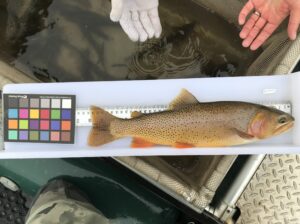
Image credit: Jeffrey Baldock
Tributaries hold the key to trout diversity
Author contact: Jeffery R. Baldock (baldockj@oregonstate.edu)
Diversity within a species — the range of traits that helps populations survive hazards like disease or habitat loss — can determine whether it thrives or disappears. Using a method that matches fish in the main river to their “home” streams based on DNA, researchers now show that Yellowstone trout in the Snake River of the western U.S. primarily originate in the many tributaries that flow into the river rather than in the mainstem itself. This finding helps explain why the mix of different trout genetic groups varies along the length of the river. The frequency with which fish successfully make their way from each tributary into the Snake depends on a suite of landscape factors, including distance from the mainstem, tributary size and the presence of barriers like dams and waterfalls between the two watercourses. Tributaries thus supply distinct groups of Yellowstone trout to the Snake River, helping maintain the range of traits that can buffer the species against environmental change. Based on their results, the authors argue that conservation and management efforts must expand beyond headwater streams and encompass entire tributary networks to cope with increasing environmental pressures, particularly climate change.
Read the article: Riverscape heterogeneity shapes population diversity for a migratory fish
From Frontiers in Ecology and the Environment:
“Redlining” effects linger decades later
Author contact: Travis Gallo (tgallo@umd.edu)
Decades after redlining, a discriminatory housing policy that shaped where people could live, its legacy continues to influence who has access to nature in American cities. Drawing on historical housing maps alongside satellite-based land-cover data and census information, researchers examined greenspace patterns in 177 U.S. cities and found that neighborhoods once labeled as less desirable — often home to communities of color and immigrants — still lag in the availability of urban natural areas. Introduced in the early 1930s and formally ended by the late 1960s, redlining categorized communities based on perceived investment risk, reinforcing patterns of disinvestment. The study shows that areas once designated as “Definitely Declining” or “Hazardous” continue to contain fewer, smaller and more fragmented greenspaces than higher-ranked neighborhoods. Because these areas are still more likely to be home to lower-income residents and communities of color, the findings highlight persistent inequities in access to the physical and mental health benefits associated with urban nature. More than half a century later, the uneven distribution of greenspace reflects the enduring imprint of historical policies on the structure and experience of U.S. city landscapes.
Read the article: Legacy effects of redlining on the distribution of greenspaces in US cities
From Ecology:
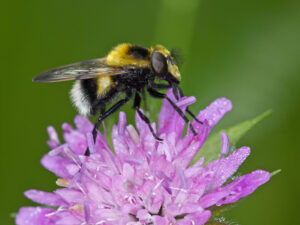
Image credit: AnneSorbes, CC BY-SA 3.0, via Wikimedia Commons
Climate change posing a challenge to copycats
Author contact: Blessing Umeh (blessing.c.umeh@nord.no)
Pretending to be something more dangerous might be a nifty trick for keeping predators at bay, but this ploy only works if the mimic and its model overlap in space and time. Now, a new study in Scandinavia suggests that climate change may be driving a wedge between an insect imitator and the species it copies. Analysis of 150 years of flight records reveals that while mimic hoverflies still emerge at roughly the same time of year, many of the bumblebee species they masquerade as have begun to appear much earlier in spring. This shift in emergence time has become so pronounced that the two insects have essentially switched positions — in the past, hoverflies emerged before bumblebees, but in recent decades the bumblebees have been showing up first. Having fewer bumblebees around may mean that predators do not learn to avoid the harmless hoverflies, reducing the protection that mimicry offers. The study is further evidence of how climate change is altering the complex interactions and relationships among species by disrupting the timing of ecological events.
Read the article: From lagging to leading: Increased phenological asynchrony in a Batesian mimicry complex
From Ecosphere:
A simple trick for boosting prairie diversity
Author contact: Daniel L. Hernández (hernandez@carleton.edu)
Restoring native grasslands offers major benefits for biodiversity and ecosystem services, yet managers face a persistent challenge: how to maintain balance among many coexisting plant species when a few aggressive ones tend to take over. In tallgrass prairie restorations in Minnesota, experimental plots with seed mixes that included or excluded two dominant species, big bluestem and Indian grass, were established and tracked over 13 years. Researchers found that plots without these dominant grasses supported a richer mix of plants than those where they were present from the start. In addition to greater plant diversity, exclusion plots showed distinct physical conditions, with more light reaching the ground, smaller root systems and lower soil carbon and moisture levels. These differences persisted even after big bluestem or Indian grass eventually colonized the plots, suggesting that simply delaying their establishment can have long-lasting effects on community structure and ecosystem processes. The results point to a key tradeoff in restoration: while dominant species play important functional roles, their early presence can crowd out diversity. Deliberately excluding them during initial planting may therefore offer a simple, low-cost way to promote more diverse and balanced prairie ecosystems over the long term.
Read the article: Exclusion of dominant grasses from a prairie seed mix has long-term impacts on species richness and ecosystem properties
###
Learn more about the upcoming ESA Annual Meeting, July 26–31, on the meeting website.
ESA invites press and institutional public information officers to attend for free. To register, please contact ESA Public Affairs Manager Mayda Nathan directly at mayda@esa.org.
The Ecological Society of America, founded in 1915, is the world’s largest community of professional ecologists and a trusted source of ecological knowledge, committed to advancing the understanding of life on Earth. The 8,000 member Society publishes six journals and a membership bulletin and broadly shares ecological information through policy, media outreach, and education initiatives. The Society’s Annual Meeting attracts 4,000 attendees and features the most recent advances in ecological science. Visit the ESA website at https://www.esa.org.
Follow ESA on social media:
X/Twitter – @esa_org
Bluesky – @ecologicalsociety.bsky.social
Instagram – @ecologicalsociety
Facebook – @esa.org