2023-2025
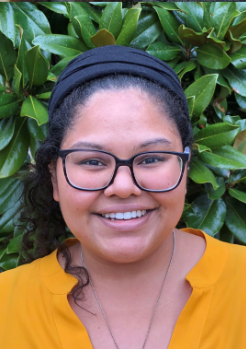
Dr. Sara Bombaci – Assistant Professor in the Department of Fish, Wildlife, and Conservation Biology at Colorado State University.
Her multidisciplinary research blends conservation science and social science to explore how ecological systems interact with social and environmental gradients in pursuit of innovative solutions to conserve biodiversity while meeting diverse human needs. Her current research areas include acoustic ecology, urban ecology, community-centered conservation and human-wildlife interactions. Bombaci also has over a decade of experience conducting research, teaching and outreach to foster greater equity and inclusion in STEM. She received her master’s and PhD degrees at Colorado State University. She is a Latina Scientist, an NSF Graduate Research Fellow, Ford Fellow, National Geographic Explorer and now an ESA Excellence in Ecology Scholar.

Colorado State University
Dr. Danielle Ignace – Assistant Professor at the University of Minnesota
She is a member of the Coeur d’Alene tribe and an ecophysiologist studying the impacts of climate change, fire and introduced species on ecosystem health and Indigenous communities in the United States and Canada. As an advocate for underrepresented groups in science, she emphasizes Indigenous Knowledge and science communication in transdisciplinary projects. Always seeking ways to enhance diversity and inclusion, Ignace currently serves as an elected Officer for the Traditional Ecological Knowledge Section of the Ecological Society of America and the Chair of the Equity, Diversity and Inclusion Committee for the American Society of Plant Biologists. She is an Associate Editor for the journal Elementa: Science of the Anthropocene, which is a trans-disciplinary, open-access journal committed to the facilitation of collaborative, peer-reviewed research.

Dr. Aidee Guzman – postdoctoral researcher at the Lawrence Livermore National Lab.
She recently completed a postdoctoral fellowship at the University of California-Irvine. She received her PhD in 2021 from the Univ. of California – Berkeley. She is an agroecologist who is motivated by the question: in a changing climate, how do we design agricultural landscapes that work for both the environment and people? She studies how agricultural management impacts biotic interactions, below- and above-ground, and ecosystem functioning. Her research also includes collaborations with social scientists to examine the socio-political drivers and barriers inherent within agricultural systems. The overall goal of her research is to support farmers – especially those who are historically underserved – through research, education, and outreach that builds on their innovations and demonstrates ecological pathways to agricultural resilience.

Dr. Lynette Strickland– Assistant Professor at Boston University
She is interested in understanding the ecological and genomic mechanisms that contribute to and promote the maintenance of variation in natural populations. The focus of her work is on insect communities investigating the ecological and genomic mechanisms underlying extensive color variation across geographic populations of Neotropical tortoise beetles. Her research explores how color functions as an adaptive phenotype and how insects use color as tools for communication both within a species, such as in mate choice and across species as predator defenses. While her fondness for beetles led to her current research program, it is her identity as a Black/Mexican woman and a first generation student from a low-income neighborhood in Texas that fostered her need to question the structures and systems that hinder, or actively deter, Black, Indigenous and other scientists of color from thriving in academic settings. She dedicates the same amount of time to outreach, and publications related to DEIJ in STEM issues, as she does to her research related to the ecology and evolution of beetles.