
Beavers leave a trail as they head into the Arctic
New research uses tree rings and satellites to date changes made by beavers to the Arctic landscape.
New research uses tree rings and satellites to date changes made by beavers to the Arctic landscape.

New research reveals how warming temperatures and environmental factors are affecting rainbow trout survival in the Stellako River, offering valuable insight to support sustainable freshwater fish populations.
Ezenwa, who was elected as a lifelong fellow, researches the ecology and evolution of infectious diseases in wild animals.
A new study shows that redistributing water sources can increase mating opportunities and strengthen genetic diversity in wild animal populations.
Rising stream temperatures may be weakening the foundation of river food webs by altering how carbon moves through these watery ecosystems.
Bethany Bradley, UMass Amherst professor of environmental conservation, has been elected to the Ecological Society of America’s class of 2026 Fellows.
Corey Callaghan, an assistant professor at the University of Florida’s Institute of Food and Agricultural Sciences, has been selected as an Early Career Fellow of the Ecological Society of America.
Lianhong Gu, distinguished staff scientist in the Biological and Environmental Systems Science Directorate at the Department of Energy’s Oak Ridge National Laboratory, has been named a fellow of the Ecological Society of America.
New research shows habitat restoration projects have paid off.
A new study finds that some cultivated flowers can support bees, butterflies, and other pollinators.
Tiny predators attempt to stay away from herbivorous caterpillars so as not to get eaten.
Wildfires are a common and growing risk across Canada, but new research highlights how increasing wildfire activity influences biodiversity in northern Saskatchewan.
Characteristics that make organisms more resilient to climate change are key to future-proofing environments, say researchers.

A global review of studies spanning 79 sites distributed across six continents evaluates ecosystem services provided by rangelands.
Two UC Santa Barbara faculty members have been named among the Ecological Society of America’s 2026 fellows.
Claire Willing, a University of Washington assistant professor of environmental and forest science, was named an Early Career Fellow by the Ecological Society of America.
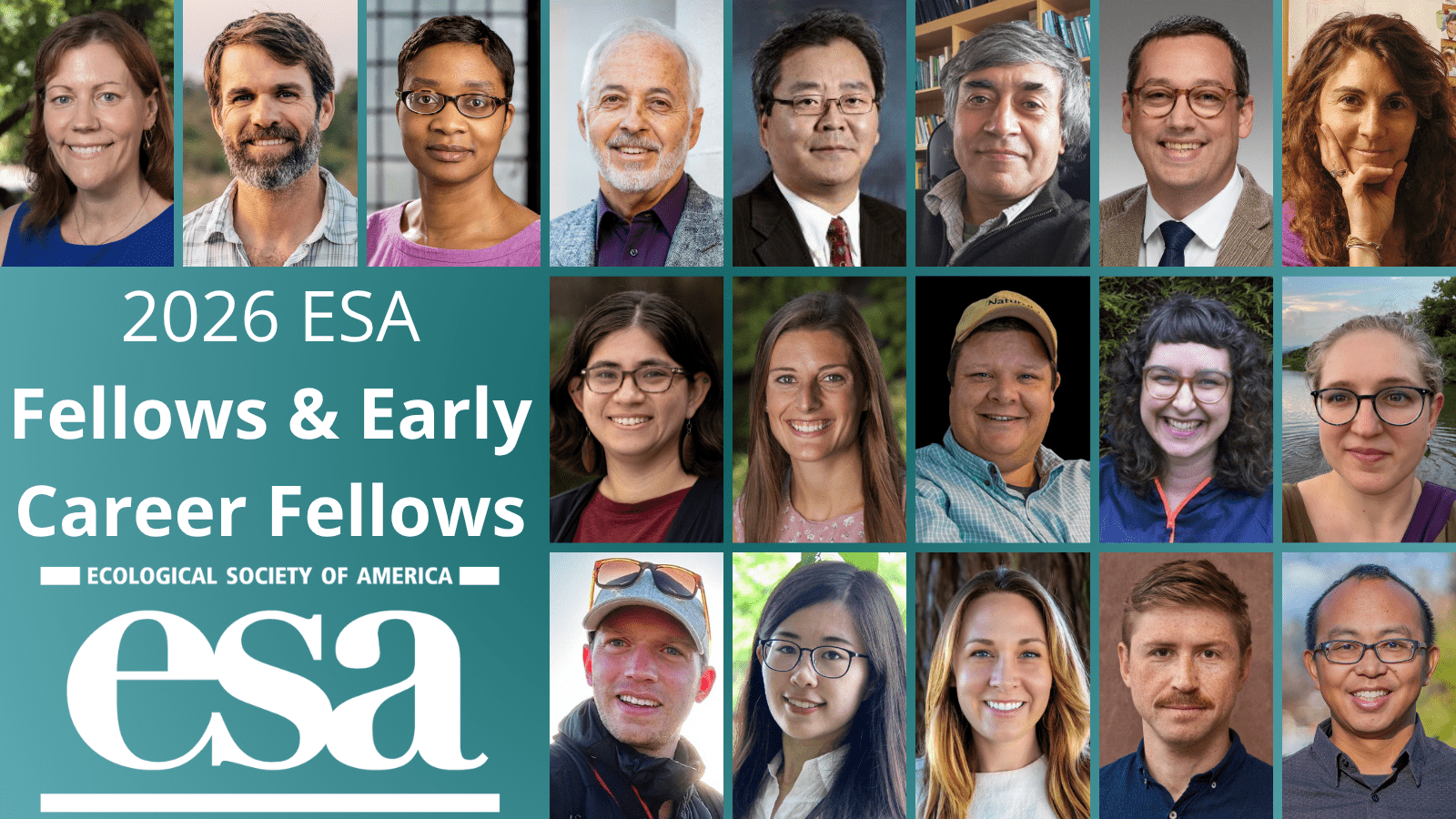
The Ecological Society of America is pleased to announce its eight new Fellows and ten new Early Career Fellows.

A recent study shows that pollinators help maintain plant biodiversity, suggesting that significant decreases in pollinators could cause a “plant-pollinator extinction vortex.”
A new study introduces a novel “demand and supply” framework that offers deeper insights into habitat quality and population dynamics of migratory birds.
For the first time, night-flying hawkmoths are found to pollinate flowers that produce colored nectar.