Research news from the Ecological Society of America’s journals
September 18, 2026
For Immediate Release
Contact: Mayda Nathan, mayda@esa.org
The Ecological Society of America (ESA) presents a roundup of five research articles recently published across its esteemed journals. Widely recognized for fostering innovation and advancing ecological knowledge, ESA’s journals consistently feature illuminating and impactful studies. This compilation of papers explores where giant salamanders sit in the food web, how to choose species for monitoring, animal biorhythms in subterranean environments, nutrient pollution in seagrass ecosystems and the conservation value of China’s fengshui forests.
From Ecology:

Image credit: Smithsonian’s National Zoo | CC BY-NC-ND 2.0
A giant salamander’s rise to the top
Author contact: Clément Duret (clement.duret@uliege.be)
Adult Japanese giant salamanders can reach an enormous 1.5 m (5 ft) in length, making them among the world’s largest amphibians. A new study shows that, as adults, these giant salamanders are not simply larger versions of the same predator they were when young. By analyzing naturally occurring chemical markers in animal tissues that reveal who is eating whom in a food web, researchers found that growing to such an extreme size radically changes the ecological role the salamanders play in freshwater ecosystems. Juvenile salamanders compete with fish, prawns and turtles for the same prey in the fast-flowing mountain rivers and streams where they live. As they develop, however, they move higher up the food chain and begin to assume a more distinct ecological niche, setting themselves apart from their former competitors. By the time they reach maturity, the salamanders have become top predators and even target many of the same species with which they once competed. Thus, as Japanese giant salamanders grow from modest youngsters to massive adults and switch to larger prey, they reshape nutrient movement through river food webs and increase overall ecosystem complexity. This changing impact with size has important conservation implications, as the loss of salamanders at juvenile, intermediate and adult life stages could have very different effects on freshwater ecosystems in Japan.
Read the article: When giant amphibians rule the river: Community trophic structure of Japanese giant salamander ecosystems
From Ecological Applications:
Choosing nature’s early warning signals
Author contact: Tuuli Rissanen (tuuli.rissanen@helsinki.fi)
As biodiversity changes in response to climate change, forest management and other pressures, scientists face a practical challenge: it is impossible to continuously monitor every species in an ecosystem. Routine monitoring of carefully chosen plants or animals can help detect ecological change, but selecting the wrong species to track can be a costly blunder. Researchers in Finland analyzed data from 3,000 sites across the country to identify which understory plants would be the most effective “indicator” species, as they are known, for forest ecosystems. Focusing on relationships among plants and between plants and their physical environment, they found that while some species were associated with other plants and some were closely linked with environmental factors like soil type or climate, a small handful showed strong connections to both. This unique attribute marked the latter plants as especially promising indicator species, as they can signal changes in both the living and nonliving components of an ecosystem. However, forestry practices, forest condition and other factors can also shape interactions between plants and their environment, necessitating their inclusion in the selection process as well. Monitoring programs are typically expensive, time-consuming and labor-intensive, even under ideal conditions. By providing a method for selecting species that reflect changes in both the biological and physical realms, the framework could substantially improve the efficiency and effectiveness of monitoring ecosystems.
Read the article: Informing indicator species selection by combining species associations and environmental responses
From Ecosphere:

Image credit: Valentina Balestra, from Lo Parrino et al. 2026
Dark-dwellers march to the beat of their own drum
Author contact: Stefano Lapadula (stefano.lapadula.1999@gmail.com)
Many animals rely on an internal biological clock to maintain daily or seasonal routines. But what happens when an organism lives in a place where there is no daylight, little temperature variation and few other environmental cues to keep time? To find out, researchers studied a cave-dwelling salamander, a subterranean amphipod and a shrimp-like crustacean that lives in groundwater. Investigating these animals can be challenging, as they often inhabit fragile, hard-to-reach environments where intensive monitoring may be impractical or disruptive. Instead of disturbing the animals with laboratory experiments, the researchers repeatedly surveyed them in their natural habitats and looked for patterns in when they were observed, how often they appeared and how many individuals were present. If the animals consistently showed up more often during certain times, the researchers reasoned, this could indicate recurring activity driven by an internal biological clock. Using this approach, they found evidence of regular daily or seasonal activity patterns in two of the three species studied, while the third showed no clear signs of rhythmic behavior. The findings challenge the long-standing assumption that biological clocks are universally lost among the inhabitants of highly stable environments, demonstrating instead that many species retain them despite living under seemingly unchanging conditions. For scientists seeking to better understand these unusual but difficult-to-study animals, the framework provides a noninvasive and highly adaptable tool for exploring biological rhythms in organisms living under relatively constant conditions.
Read the article: The rhythm of the night: Assessing temporal variation of activity patterns in arhythmic environments from field data
From Ecological Monographs:
Too much of a good thing is bad for seagrass systems
Author contact: Zhijian Jiang (jiangzj1982@scsio.ac.cn)
While nutrients are essential for plant growth, too much of them may reduce the ability of seagrass ecosystems to move energy and key nutrients through marine food webs. Seagrass beds are major carbon stores, biodiversity hotspots and important nurseries for commercially valuable fish and shellfish. Yet researchers in China found that excessive nitrogen, phosphorus and other nutrients washing into coastal waters can make food webs less efficient. In seagrass beds exposed to high nutrient levels, the efficiency with which energy moved through the food chain fell by 32%. Essential fatty acids (nutrients required for growth, reproduction and healthy cell function) were especially affected. The researchers propose that excess nutrients alter both the nutritional quality and chemical defenses of seagrasses, making them less appealing to snails and other grazers. As a result, long-chain polyunsaturated fatty acids (PUFAs), which contribute to the nutritional value of seafood, declined by as much as 62% in their transfer through the food web. Scaled globally, nutrient-enriched seagrass beds could lose roughly 2 million metric tons of carbon energy and 63,500 metric tons of these PUFAs through food-chain transfer each year. Such reductions could ultimately affect ecosystem stability, fisheries productivity and the nutritional quality of our seafood.
Read the article: Eutrophication reduces seagrass ecosystem stability by decreasing trophic transfer efficiency of energy and fatty acids
From Frontiers in Ecology and the Environment:
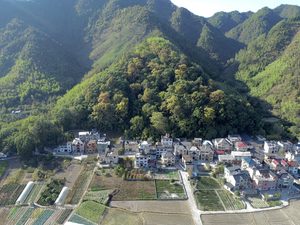
Image credit: Cheng Jin
Fengshui forests provide good fortune for conservation in China
Author contact: Yongchuan Yang (ycyangeco@163.com)
Modest in size, scattered across the countryside and exposed to greater human impact than formal nature reserves, China’s fengshui forests — small patches of woodland maintained for cultural and spiritual purposes — are nonetheless home to a remarkable diversity of plants and animals, suggests a new study. Analysis of 811 of the culturally significant woodlands dotting the southern part of the country revealed that they provide especially critical sanctuary for threatened evergreen broadleaf forests. Additionally, these forest remnants support upward of 60 rare or endangered tree species. Considering their inherent conservation value, the researchers propose that incorporating village fengshui forests into national management strategies could greatly expand the reach of biodiversity protection in China and at least partially offset the geographic limitations of formal protected areas. More broadly, the study provides further evidence that forests and other ecosystems protected for cultural, religious or other socially relevant purposes often serve as safe havens for biodiversity, even in areas where rapid human encroachment threatens to engulf everything in its path.
Read the article: Ancient practices enhance biodiversity conservation: Evidence from village fengshui forests
###
The Ecological Society of America, founded in 1915, is the world’s largest community of professional ecologists and a trusted source of ecological knowledge, committed to advancing the understanding of life on Earth. The 8,000 member Society publishes six journals and a membership bulletin and broadly shares ecological information through policy, media outreach and education initiatives. The Society’s Annual Meeting attracts 4,000 attendees and features the most recent advances in ecological science. Visit the ESA website at https://www.esa.org
Follow ESA on social media:
X/Twitter – @esa_org
Bluesky – @ecologicalsociety.bsky.social
Instagram – @ecologicalsociety
Facebook – @esa.org