October research news from the Ecological Society of America
October 22, 2026
For Immediate Release
Contact: Mayda Nathan, mayda@esa.org
The Ecological Society of America (ESA) presents a roundup of four research articles recently published across its esteemed journals. Widely recognized for fostering innovation and advancing ecological knowledge, ESA’s journals consistently feature illuminating and impactful studies. This compilation of papers explores how early-life conditions shape caribou survival and longevity, how changing ocean conditions may influence the habitat use of endangered North Pacific right whales, the risk to Maryland marshes as seas rise and how habitat disturbance can make wild mice stressed and sick.
From Ecology:
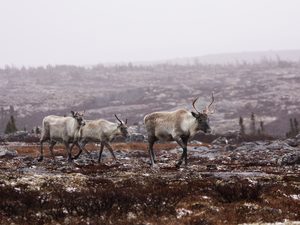
Image credit: Mattis Pelletier
A caribou’s future takes shape before birth
Author contact: Mattis Pelletier (mattis.pelletier.1@ulaval.ca)
A caribou’s chances of living a long life may depend on conditions it encounters before it even takes its first steps, according to a new study of two migratory herds in northern Québec and Labrador. Researchers analyzed more than 20 years of data on 396 female calves, finding that harsh snow conditions during pregnancy and limited food availability late in pregnancy and shortly after birth were linked to poorer body condition during the calves’ first year. The study also found that early-life competition for resources was strongly associated with shorter lifespans among caribou that survived to adulthood, suggesting that conditions early in life may shape survival long after the calf stage. The findings offer insight into factors that may affect caribou survival and population dynamics, an important question for two migratory herds that have declined dramatically over the past 25 years. The Rivière-aux-Feuilles herd declined by about 75%, while the Rivière-George herd declined by approximately 98%. Understanding how early-life conditions relate to survival and longevity could help researchers better understand the challenges facing these animals and inform conservation efforts.
Read the article: Doomed from the start: Consequences of a harsh early life on life-history traits of a wild Arctic ungulate
From Ecological Applications:
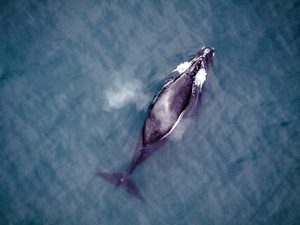
Image credit: NOAA Fisheries
Listening for clues to the fate of endangered right whales
Author contact: Dana L. Wright (danawr4@uw.edu)
With fewer than 50 individuals remaining, the eastern population of the North Pacific right whale faces an uncertain future. New research suggests that changes in the Bering Sea’s cold bottom waters may be linked to where these whales are detected, offering clues to how a warming ocean could affect their habitat. Researchers analyzed underwater recordings from seven locations in the eastern Bering Sea between 2012 and 2019. During years when the area of cold bottom water shrank, whale calling activity expanded northward. But in 2018 and 2019, when the cold pool reached record-low levels, whale calls were detected far less often across most monitored locations. The contrasting patterns suggest that the relationship between ocean conditions and whale activity may not be straightforward. The cold pool helps shape the distribution of the whales’ prey, so changes in this underwater habitat could affect where the whales find food. Researchers found no clear link between the timing of whale arrivals and departures and seasonal sea ice timing, suggesting that the ocean conditions created by sea ice may matter more than the timing of ice formation and retreat itself. The findings highlight the importance of understanding how a changing Bering Sea could reshape habitat for a population already at risk of extinction.
Read the article: Habitat use by critically endangered North Pacific right whales linked to sea ice dynamics at varying spatial scales
From Ecological Monographs:
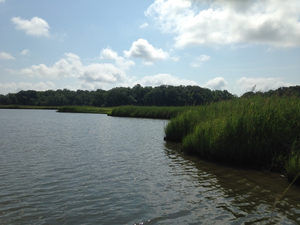
Image credit: James Holmquist
Rising seas could turn a Maryland marsh into open water by the 2060s
Author contact: James R. Holmquist (holmquistj@si.edu)
A low-lying marsh along Maryland’s Chesapeake Bay has a greater than 50% chance of converting to open water by the 2060s, according to a new study. The loss could reduce the wetland’s ability to store carbon, as well as threaten habitat and other benefits coastal wetlands provide. But predicting the future of a marsh is inherently uncertain: scientists must account for everything from measurement errors and gaps in ecological knowledge to the future pace of sea-level rise. To tackle that challenge, researchers developed an approach that accounts for these different sources of uncertainty, revealing not only what is likely to happen, but how confident scientists can be in the forecast and which unknowns matter most. Their analysis found that the growth of marsh plants and the preservation of organic matter in the soil play especially important roles in determining whether the wetland can maintain its elevation as seas rise. It also showed that different sources of uncertainty become important at different times, with uncertainty about future sea-level rise playing a larger role later in the century. The findings highlight that marsh survival depends not only on how quickly sea levels rise, but also on how the wetland’s plants and soils respond. The forecasting approach could help coastal managers assess which wetlands are most vulnerable, prioritize restoration efforts and identify where better data could improve predictions of wetland survival and long-term carbon storage.
Read the article: Probabilistic forecasting of coastal wetland elevation and soil carbon response to sea-level rise
From Ecosphere:
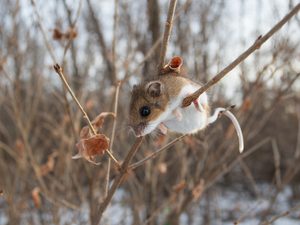
Image credit: Mike Budd/USFWS | Public Domain
Habitat damage may leave wild mice stressed and less able to fight infection
Author contact: Laurie Dizney (dizney@up.edu)
Wildlife can sometimes survive in damaged habitats, but staying alive may come at a cost. A four-year study of western deer mice in Oregon found that mice in the most disturbed habitats showed signs of greater long-term stress and weaker immune defenses. But there was also encouraging news: mice at sites where habitat restoration had been underway for 8 to 12 years had stress-hormone levels and immune-cell counts that did not differ significantly from those in intact habitat. Researchers measured stress hormones preserved in the mice’s hair and counted immune cells in their blood. Mice in the most disturbed areas had higher stress-hormone levels and fewer immune cells, potentially leaving them less able to fight infection. The researchers suspect that changes in vegetation, including fewer trees and shrubs and warmer soil, may help explain these differences. The findings suggest that habitat damage may affect wildlife health even when animals continue to inhabit disturbed areas, and that restoration may help improve some physiological measures of health. Measuring stress hormones and immune cells could give conservationists another way to evaluate restoration progress and investigate how habitat changes may influence wildlife susceptibility to disease.
Read the article: Effects of habitat disturbance on physiological metrics of deer mice (Peromyscus sonoriensis)
###
The Ecological Society of America, founded in 1915, is the world’s largest community of professional ecologists and a trusted source of ecological knowledge, committed to advancing the understanding of life on Earth. The 8,000 member Society publishes six journals and a membership bulletin and broadly shares ecological information through policy, media outreach and education initiatives. The Society’s Annual Meeting attracts 4,000 attendees and features the most recent advances in ecological science. Visit the ESA website at https://www.esa.org
Follow ESA on social media:
X – @esa_org
Bluesky – @ecologicalsociety.bsky.social
Instagram – @ecologicalsociety
Facebook – @esa.org