Research news from the Ecological Society of America’s journals
November 5, 2026
For Immediate Release
Contact: Mayda Nathan, mayda@esa.org
The Ecological Society of America (ESA) presents a roundup of five research articles recently published across its esteemed journals. Widely recognized for fostering innovation and advancing ecological knowledge, ESA’s journals consistently feature illuminating and impactful studies. This compilation of papers explores what island snails can teach us about biodiversity, why winter recreation may be stressing wildlife in the Alps, how people and climate jointly drive wildfire patterns in India, how communities are restoring neglected urban forests, and whether ecological experiments conducted in a single bog can accurately predict ecosystem change across thousands of miles.
From Ecological Monographs:

Image credit: Konstantinos Proios
At a snail’s pace, cracking island biodiversity
Author contact: Konstantinos Proios (konproios@biol.uoa.gr)
What determines how many species can thrive on an island? To help answer one of biogeography’s oldest questions, researchers analyzed data from 727 islands worldwide to examine how 14 factors, from island size and climate to isolation and human presence, shape the diversity of land snails. Land snails were chosen because they are among the most diverse and highly endemic island animals, making them especially useful for studying how biodiversity arises and is maintained. Including such a wide range of variables greatly improved the analysis, collectively explaining up to 84% of the differences in endemic snail diversity among islands, far more than traditional approaches based mainly on island area or energy availability. The study also found that different groups of snails respond to island conditions in different ways: species found only on one island or island group were strongly shaped by factors such as area, isolation, climate, and habitat diversity, whereas native species that also occur elsewhere appeared to be influenced more by broader regional species pools and colonization processes. Overall, the results show that the same major forces known to shape island plants and vertebrates also govern the diversity of land snails, helping extend long-standing theories of island biogeography to the invertebrates that make up most of Earth’s animal species.
Read the article: A global analysis of land snail diversity on islands
From Ecological Applications:
Black grouse are poor sports in winter
Author contact: Luca Nelli (luca.nelli@glasgow.ac.uk)
While zooming downhill on skis may be thrilling for humans, it may not be so enjoyable for local wildlife. To better understand how winter recreation affects mountain animals, researchers focused on black grouse, a bird that is highly sensitive to human disturbance and is already declining across much of Europe. Analysis of 235 black grouse poop samples, collected from the birds’ snow burrows in Italy’s Gran Paradiso National Park, revealed elevated levels of stress hormones when large numbers of skiers were present on nearby slopes. Chronic stress, combined with the grouses’ energetic costs of fleeing high-traffic areas, threaten the survival of a species already challenged by climate change, habitat loss and other human pressures. Based on their findings, the researchers developed an interactive web app that maps predicted grouse stress under different skiing and environmental scenarios, giving scientists and ski resort managers a practical tool for identifying disturbance hotspots and exploring ways to minimize impacts on local populations. The study is a further reminder that even seemingly peaceful winter recreation can leave a measurable mark on wildlife.
Read the article: Skiers’ footprint on wildlife stress: Tracing the impact of winter sports on black grouse with interactive mapping
From Ecosphere:
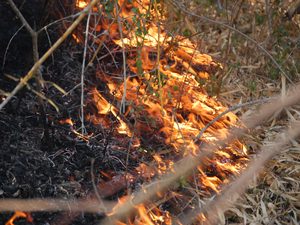
Image credit: Narendran Kodandapani
People and climate shape India’s fire patterns
Author contact: Narendran Kodandapani (svknaren@gmail.com)
Wildfire has been studied extensively in Africa, the Americas and elsewhere, yet surprisingly little is known about prevailing fire patterns in India. To address this gap, researchers used satellite data to examine fire occurrence in 13 Indian wildlife reserves since 2002, and to assess the relationship between humans and wildfire in the world’s most populous country. The research team found that both environmental conditions and people play important roles: hot, dry weather can make vegetation more prone to burning, while human activities such as land use, resource extraction, fire management and population growth can either increase or reduce fire activity depending on the local context. Across the reserves studied, climate and human factors accounted for between 21% and 77% of annual fire activity. Fire patterns varied greatly by region, with the Eastern Ghats featuring both the highest fire activity and fastest rate of annual increase, while fire activity declined in the Western Ghats. The findings underscore that there is no single explanation, or single solution, for wildfire across India. Instead, effective management will require approaches tailored to local ecological conditions and human influences, helping safeguard forests, savannas, wildlife and nearby communities as climates and landscapes continue to change.
Read the article: Changing fire regimes in wildlife reserves of southern India: Trends, drivers, and conservation challenges
From Frontiers in Ecology and the Environment:
It takes a village to maintain urban forests
Author contact: Nancy F. Sonti (nancy.f.sonti@usda.gov)
Small patches of forest in cities benefit biodiversity but also enhance human well-being, underscoring their value to urban wildlife and human residents alike. The authors of this study propose that management of urban woodlands is best accomplished through partnerships among concerned parties, including scientists, land managers, city officials and local communities. They present the example of Stillmeadow PeacePark, a 10-acre forest on church-owned land in Baltimore, Maryland, where partners joined forces to tackle a suite of challenges that included invasive plants, overabundant deer, widespread tree mortality caused by invasive insects, repeated neighborhood flooding and the social disruptions of the COVID-19 pandemic. Rather than relying on outside experts alone, community members, researchers, government agencies and nonprofit organizations collaborated to create an “urban experimental forest,” removing hazardous dead trees, establishing tree nurseries and research plots, restoring native forest habitat and creating outdoor spaces for recreation, education and community gathering. The project also supported job-readiness and workforce-training programs that introduced local residents to careers in forestry and environmental restoration. Just as importantly, community-driven stewardship of urban forests can help ensure that historically underserved residents, communities and neighborhoods have a meaningful role in protecting urban biodiversity and shaping broader conservation efforts.
Read the article: Co-producing urban silviculture: a stone soup approach to transdisciplinary science
From Ecology:
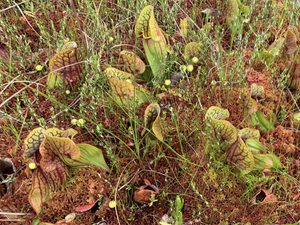
Image credit: Lindsey Pett
Making a pitch for small-scale experiments
Author contact: Lindsey A. Pett (lpett@norwich.edu)
Can ecologists trust what happens in a single experiment to reflect what happens across an entire continent? Researchers tackled this long-standing question by testing whether the effects of supplemental nutrients measured in a small, localized experiment match patterns seen across thousands of kilometers of real-world habitats. Using the self-contained aquatic ecosystem that forms inside the leaves of purple pitcher plants, they added realistic amounts of nitrogen and phosphorus to plants in a Vermont bog and measured changes in nutrients, microbes, algae and other organisms living within the pitchers. The team then compared those results with surveys of pitcher plants at 28 sites stretching from Maine to Florida. Despite the vast difference in geographic scale, the two approaches produced remarkably similar results: more than 80% of the ecological relationships observed in the experiment also appeared across the regional survey. In both cases, nutrient enrichment, especially phosphorus, increased nutrient levels in pitcher fluid and plant tissues and boosted plant growth. Although a few responses differed between the local and regional analyses, particularly among organisms higher in the food web, the overall agreement suggests that carefully designed small-scale experiments can reliably predict many ecosystem responses to nutrient deposition across broad landscapes.
Read the article: Experiment and natural variation in N and P inputs elucidate complexity in freshwater ecosystems
###
The Ecological Society of America, founded in 1915, is the world’s largest community of professional ecologists and a trusted source of ecological knowledge, committed to advancing the understanding of life on Earth. The 8,000 member Society publishes six journals and a membership bulletin and broadly shares ecological information through policy, media outreach and education initiatives. The Society’s Annual Meeting attracts 4,000 attendees and features the most recent advances in ecological science. Visit the ESA website at https://www.esa.org
Follow ESA on social media:
X – @esa_org
Bluesky – @ecologicalsociety.bsky.social
Instagram – @ecologicalsociety
Facebook – @esa.org