National Field Trips
The Dr. Henry L. Gholz SEEDS National Field Trips
The SEEDS program hosts National Field Trips to bring undergraduate students from diverse backgrounds and interest to explore the science of ecology. We sponsor diverse students currently enrolled in undergraduate studies at a US institution to travel to different research stations to engage with scientists and professional with hand on learning experiences and workshops to discuss career development and the future of our science field. Diverse People for a Diverse Science!
Read more about our past SEEDS Field Trips.
SEEDS National Field Trip to the
University of Virginia, Mountain Lake Biological Station
August 27-30, 2026
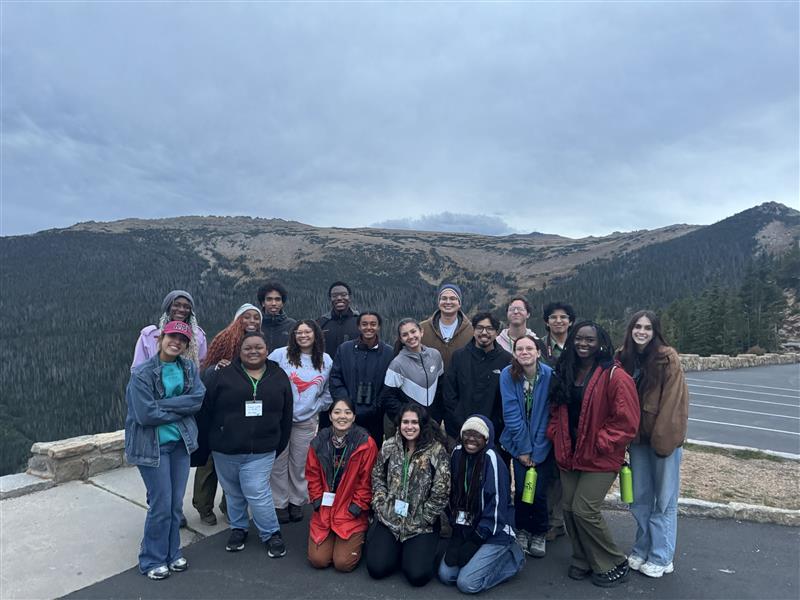
Join the SEEDS Program at another unique Field Trip to the amazing Mountain Lake Biological Station in Pembroke, VA!
Established in 1930, the Mountain Lake Biological Station is a full-service residential field station located atop Salt Pond Mountain in the southern Appalachians of southwest Virginia. Programs include summer field courses, Research Experiences for Undergraduates (REU), numerous faculty-driven research projects, scientific meetings, outreach activities, and more. An average high-season day at MLBS hosts 50-100 people, including undergraduate and graduate students, research faculty from around the world, and family members. Everyone in the community works, eats, and lives together everyday, integrating research and mentorship in the truest sense of a Jeffersonian “academical village.” The Station is remote but accessible, and is surrounded by sharp ecological gradients and fine-scale changes in habitat– ideal conditions for studying ecology and evolution. Visiting scientists conduct research in plant and animal population biology, behavioral ecology, life history evolution, community ecology, ecological genetics, biosystematics, epidemiology, conservation biology, and the physiology of behavior.
The station sits on a remote wooded ridge at an elevation of 1,160m (3,800ft) precisely on the divide between the Atlantic and Mississippi drainage basins in the Appalachian Mountains of southwestern Virginia. The variety of rich and diverse habitats near MLBS provide excellent opportunities for studies in terrestrial and aquatic field biology. Mixed deciduous forests, mountain streams, successional meadows, a large natural lake, ponds, rocky ridges, sphagnum bogs, stands of red spruce, Canadian hemlock, white pine, and both disturbed and virgin habitats are all within walking distance of the Station. Because MLBS is located on the eastern continental divide and is surrounded by strong elevational and environmental gradients, it is uniquely situated to provide abundant opportunities for observational and experimental studies on scales relevant to the ecology and evolution of many plant and animal populations.
Eligibility
- Must be a current undergraduate student enrolled in an Associates or Bachelors degree at a college/university within the United States of America
- Preference is given to first and second year, and those that have NOT had opportunities to engage in ecology research or field experience.
- This opportunity is open to ALL students in the United States of America with a strong interests in ecology.
Selection Criteria
SEEDS looks for future leaders within the science of ecology, a strong candidate must demonstrate:
- A sincere interest in exploring a career in ecology related fields.
- The potential to contribute to the ecology program at their home institution and in their communities.
- The capacity to support the mission of SEEDS – to stimulate and nurture the interest of students to participate and be leaders in ecology
- A strong statement of interest essay.
- Students applying from SEEDS Chapters are strongly encouraged. To check the status of your SEEDS Chapter, please visit our Chapter Map.
Logistics for the Field Trip
The SEEDS Program will cover all the selected participants expenses for this field trip including travel, lodging, ground transportation and meals. This is a fully funded opportunity, students who are chosen to participate will work with SEEDS staff to arrange their travel itineraries, housing preferences, ground transportation, and dietary needs. SEEDS staff establishes an agenda with the station host and takes care of all the necessary arrangements for a great participant experience!
You just need to worry about making it to and from your home airport.
Field Trip Agenda includes:
- Science Workshops and discussions
- Hands-on field research experience
- Cultural components to the location we visit.
- Career panel discussion with professionals and graduate students
- Student presentations
- Reflections on motivations students face in science
- Time for group daily journal entries which are then compiled into a single report
Applications Materials
These are the materials you will need to complete the application for this field trip.
- Applicant contact and academic information.
- Statement of Interest: In a short (up to 400 word) essay(1) describe the nature of research that you intend to pursue; (2) specify how this Field Trip experience would further your educational and career goals; (3) summarize your ecology experience thus far (activities, coursework, research or work experience, etc.); (4) explain how you will contribute to the mission of the SEEDS program during and after the Field Trip. Uploaded in PDF format.
- Resume or CV. Uploaded in PDF format.
- Reference: Name and email contact of a professional reference.

Click on the APPLY image above to visit our application portal.
The application portal will close on June 9, 2026 at midnight local time.
SEEDS National Field Trips are funded by the Dr. Henry L. Gholz SEEDS Field Trip Endowment.