FSU doctoral candidate receives Ecological Society Policy Award
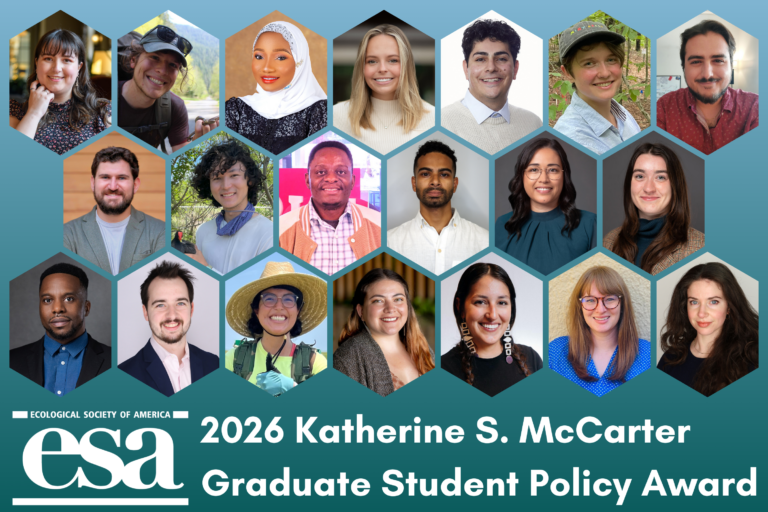
Lillie M. Bradshaw has earned the Katherine S. McCarter Graduate Student Policy Award from the Ecological Society of America.
Lillie M. Bradshaw has earned the Katherine S. McCarter Graduate Student Policy Award from the Ecological Society of America.

The findings suggest that generalist carnivores such as foxes and martens may play a previously unknown role in the natural control of this forest pest.

A new global bank of bird sounds lets scientists “hear” how ecosystems are doing — and improve conservation efforts.
A tropical insect has been found to change colour from vivid hot pink to green within a fortnight, which scientists believe may mimic the young leaves of rainforest plants.
A deep-ocean survey of methane seeps off the Japanese coast reveals far more biodiversity than previously believed.
A new study reveals concerning trends in tick-borne threats.
Northern Michigan University master’s candidate Noah Andexler is one of 20 graduate students nationwide selected to receive the Ecological Society of America’s 2026 Katherine S. McCarter Graduate Student Policy Award..

A new framework aims to help land managers prioritize sites for restoration to optimize limited conservation resources while supporting ecosystem resilience.
Old datasets show changes in flight patterns and missing moth species in Ithaca, N.Y.
A new study by the University of Würzburg shows which areas in rural settlements are particularly rich in insects – and where there is still room for improvement.
Marine biologists trace progression of decline over at least seven generations of giant kelp with potentially widespread consequences.
By coupling GPS tracking with satellite images, a Danish rewilding study demonstrates how large herbivores are the key to a bright, open and varied landscape.
The flowering lupine has become a familiar feature along Swedish roads – a new study survey of the invasive species’ occurrence in Sweden.
Koa Grabar, of the University of Hawaiʻi at Mānoa, has been named a recipient of the 2026 Katherine S. McCarter Graduate Student Policy Award.
Fish-eating killer whales in southern Alaska have a diverse, seasonally changing diet featuring salmon and groundfish, according to a new study.
Lily Olmo, a Ph.D. student in Fisheries, Wildlife, and Conservation Sciences at Oregon State University, is one of 20 recipients of the Ecological Society of America’s 2026 Katherine S. McCarter Graduate Student Policy Award.
Olabisis Atofarati and Chukwudi Ikegwu are recipients of the Ecological Society of America’s 2026 Graduate Student Policy Award.
A doctoral student from the Ohio State University’s Department of Evolution, Ecology and Organismal Biology was recently named the recipient of the Ecological Society of America’s 2026 Katherine S. McCarter Graduate Student Policy Award.
Doctoral candidate Sikander Khare has been selected for the 2026 Katherine S. McCarter Graduate Student Policy Award by the Ecological Society of American, one of the nation’s leading organizations dedicated to advancing ecological science.
New research finds that different farming practices influence whether uncultivated areas next to fields help or hinder farmers.