
CONICET scientists are evaluating strategies to improve grassland productivity without threatening biodiversity
A global review of studies spanning 79 sites distributed across six continents evaluates ecosystem services provided by rangelands.
A global review of studies spanning 79 sites distributed across six continents evaluates ecosystem services provided by rangelands.

Dr. Tess Grainger, University of Guelph assistant professor in Integrative Biology, has been named an Early Career Fellow with the Ecological Society of America.
Two UC Santa Barbara faculty members have been named among the Ecological Society of America’s 2026 fellows.
Claire Willing, a University of Washington assistant professor of environmental and forest science, was named an Early Career Fellow by the Ecological Society of America.
The Ecological Society of America is pleased to announce its eight new Fellows and ten new Early Career Fellows.

A recent study shows that pollinators help maintain plant biodiversity, suggesting that significant decreases in pollinators could cause a “plant-pollinator extinction vortex.”
A new study introduces a novel “demand and supply” framework that offers deeper insights into habitat quality and population dynamics of migratory birds.
For the first time, night-flying hawkmoths are found to pollinate flowers that produce colored nectar.
A new study finds both grazing mammals and plant-eating insects together play a major role in maintaining the health of Australia’s endangered grassy woodlands.
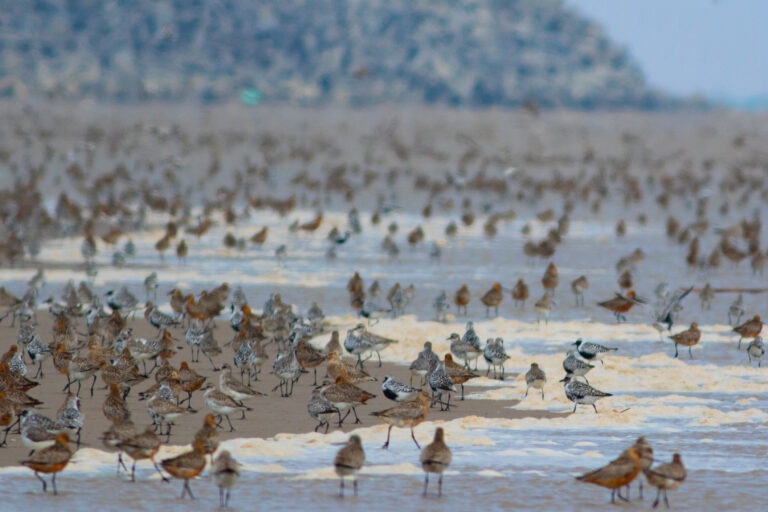
Supply and demand along birds’ migration routes, beaver impacts on tundra ecosystems and more from ESA’s journals.

New research finds polar bears are becoming smaller and less genetically diverse as sea ice disappears, underscoring the need for genetic management plans.
Returning to campus after COVID shutdowns, students enrolled in a UCSB biology course made an exciting discovery.
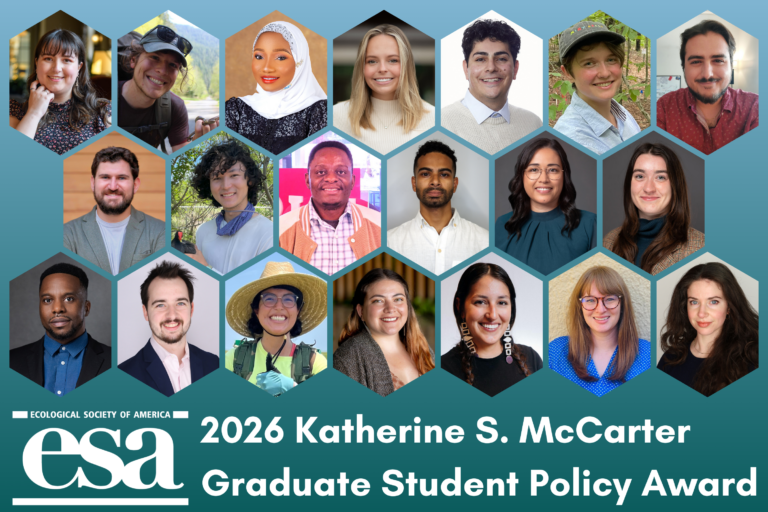
Lillie M. Bradshaw has earned the Katherine S. McCarter Graduate Student Policy Award from the Ecological Society of America.

The findings suggest that generalist carnivores such as foxes and martens may play a previously unknown role in the natural control of this forest pest.
A new global bank of bird sounds lets scientists “hear” how ecosystems are doing — and improve conservation efforts.
A tropical insect has been found to change colour from vivid hot pink to green within a fortnight, which scientists believe may mimic the young leaves of rainforest plants.
A deep-ocean survey of methane seeps off the Japanese coast reveals far more biodiversity than previously believed.
A new study reveals concerning trends in tick-borne threats.
Northern Michigan University master’s candidate Noah Andexler is one of 20 graduate students nationwide selected to receive the Ecological Society of America’s 2026 Katherine S. McCarter Graduate Student Policy Award..

A new framework aims to help land managers prioritize sites for restoration to optimize limited conservation resources while supporting ecosystem resilience.